Skip to content
CareRulebook
MenuClose

Where are you starting?

United StatesTexas, North Carolina, Georgia, Virginia, Indiana, Ohio, Illinois, Washington, Colorado, Tennessee, Maryland, Kansas
TexasManual
North CarolinaManual
GeorgiaManual
VirginiaManual
IndianaManual
OhioGuide
IllinoisManual
WashingtonManual
ColoradoManual
TennesseeManual
MarylandManual
KansasGuideAll US states →
United KingdomEngland
Free toolsChecklists, calculators and templates

Kansas · Home Health Agency license, supportive care · K.A.R. 28-51

How to start a home care agency in Kansas (supportive care license, 2026)

To start a home care agency in Kansas that helps clients with bathing, dressing or other personal care, you need a Home Health Agency license for Non-Medical Supportive Care Services from the Kansas Department of Health and Environment (KDHE). The license allows no nursing of any kind: a manager, not a nurse, assesses and supervises. You upload your written policies into KDHE’s 13 folders, and KDHE reviews them before it issues the license.

  • Rule-verified October 2, 2026
  • Quoted from K.A.R. 28-51 and K.S.A. 65-5101 to 65-5117
  • 26 official sources
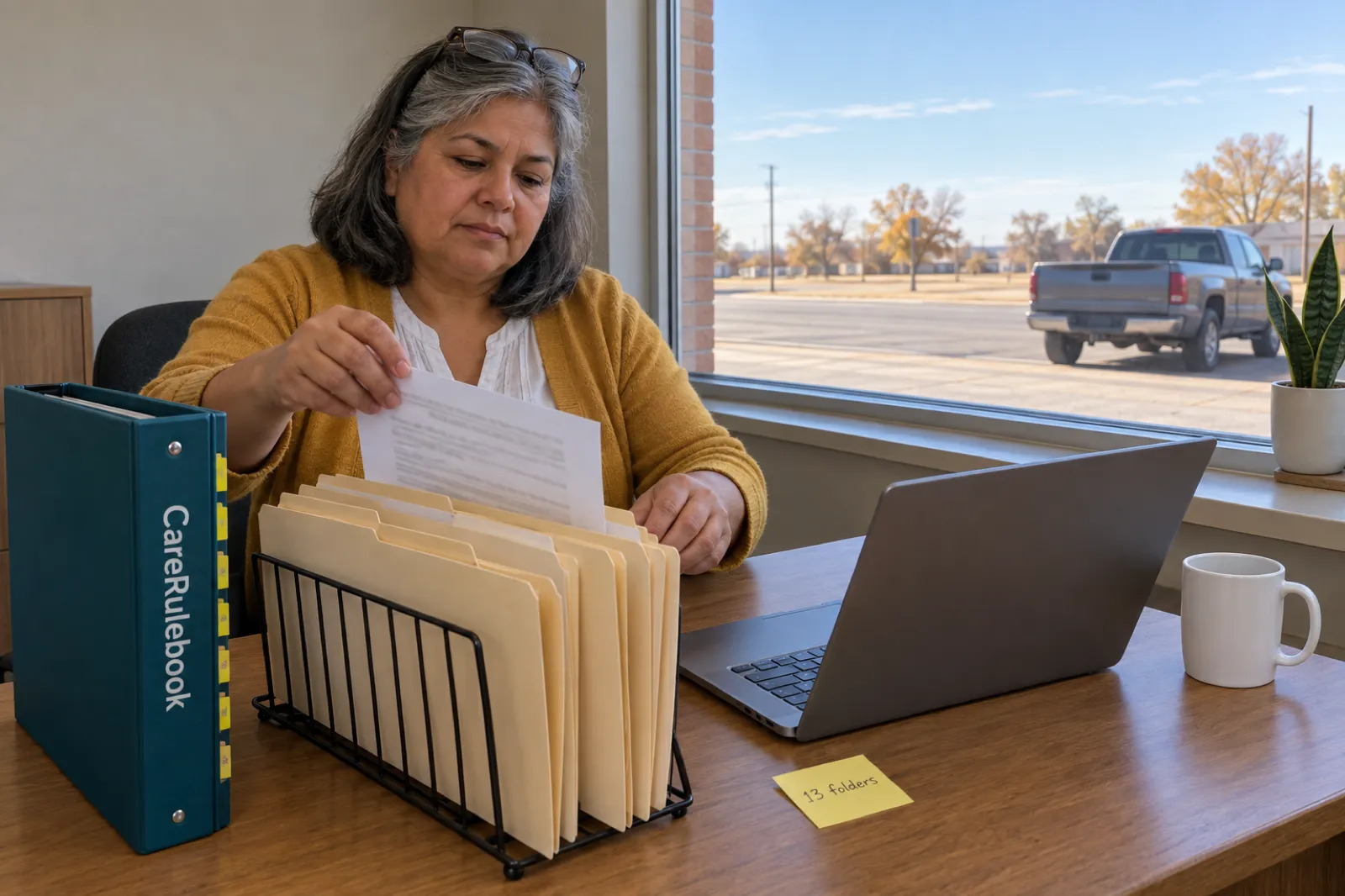
A woman in a mustard cardigan slides a printed page into manila folders in a wire file sorter on an oak desk, beside a teal CareRulebook binder with yellow tabs, a laptop and a sticky note reading 13 folders, with a pickup truck parked on a wide street outside the window

Quick answer

In Kansas, "any agency, including medicare and medicaid providers, that provides one or more of the home health services, supportive care services or attendant care services specified in K.S.A. 65-5101 ... shall be licensed in accordance with the provisions of this act." (K.S.A. 65-5102). Supportive care services are help with activities of daily living such as bathing, dressing, eating, medication reminders, transferring, walking, toileting and continence care, given without supervision by a healthcare professional (K.S.A. 65-5101(k)). KDHE, not KDADS, issues the license: "The Kansas Department of Health and Environment (KDHE) is the licensing agency for HHAs in Kansas." (KDHE Letter of Introduction). Whether homemaker-only work needs a license is not settled (below).

The license is narrow. The rule says "A person that applies for a license to provide only supportive care services shall not provide nursing services" (K.A.R. 28-51-105(e)), and KDHE’s attestation form says that includes a nurse supervising, delegating or assessing (attestation form). A manager assesses each client, writes the plan of care and visits every client every 3 months (K.A.R. 28-51-104(c)(3)), and a written policy sets limits for 16 task areas, from medication reminders to oxygen tanks (K.A.R. 28-51-117(g)).

KDHE reviews your policies before licensing. After the application and KDHE’s fee ($250 under 100 clients a year), you upload them into 13 folders, and "when all required documents have been reviewed and meet the requirements, KDHE will issue a license and notify you of your license approval." (KDHE application).

$250

KDHE’s fee to apply, if you expect fewer than 100 unique clients a year (a state fee)

K.A.R. 28-51-101(a)(1)(B)(iii)

13

Folders in KDHE’s file transfer system, each reviewed separately

KDHE Instruction Guide

16

Task areas the assigned duties policy must cover, each with its own limits

K.A.R. 28-51-117(g)

254

"State only" home health agency licenses (directory rows) in KDHE’s directory, the most there could be with this license (our count)

KDHE directory, Oct 2, 2026

Direct answers

Who licenses non-medical home care in Kansas?

The Kansas Department of Health and Environment (KDHE), not KDADS. Non-medical personal care is licensed as a home health agency with the Non-Medical Supportive Care Services license, and the license duty applies to private pay agencies too. KDADS runs the criminal record checks your workers need, the nurse aide registry and the Medicaid waiver programs.

K.S.A. 65-5102; KDHE Letter of Introduction

How much is a Kansas supportive care license?

KDHE’s fee is $250 to apply if you expect fewer than 100 unique clients a year ($500 for 100 or more), then $100 a year to renew ($350 for 100 or more). Fees are non-refundable and paid online. These are KDHE’s fees, not CareRulebook prices.

K.A.R. 28-51-101(a)(1)(B), (b)(2)

Do I need a registered nurse for a Kansas supportive care agency?

No, and you may not use one for nursing. The rule says a supportive-care-only agency shall not provide nursing services, and KDHE’s attestation form says that includes a nurse supervising, assigning, delegating, overseeing, setting up medication or doing assessments. A manager who is not a nurse assesses each client, writes the plan of care and supervises the caregivers.

K.A.R. 28-51-105(e); KDHE attestation form

Do I send my policies to KDHE before I am licensed?

Yes. After KDHE receives your application and fee, it sends a login to its file transfer system. You upload your policies, templates and 10 personnel files into 13 folders, then file a "Begin Review Process" letter. KDHE reviews the documents and issues the license when they all meet the requirements.

KDHE application instructions; Instruction Guide

Interactive check

Which Kansas license do you need?

What will your business do?

Pick the option closest to your plan.

How to start a Kansas home care agency, step by step

Tick steps off as you go. Your progress is saved in this browser only.

  1. Check that supportive care is the right license

    Before applying

    Supportive care covers hands-on help with daily living and nothing medical. Nursing, Medicaid waiver services and many payers, including Veterans Affairs, need the Skilled Services license instead. Supportive care or skilled services?

  2. Form the business and register it

    Before applying

    A corporation or LLC registers with the Kansas Secretary of State. The application asks for the entity name as filed and its registered agent, and KDHE wants the owners, officers and directors, any corporate ownership interest of 5% or more, and any past home health agency ownership or management.

  3. Appoint an administrator and an alternate

    Before applying

    Each must be at least 21, have one year of experience as a home health agency employee or in a related health care service, and hold a bachelor’s or associate degree or a certificate from a KDHE-approved administrator course. The governing body appoints the administrator in writing. Both must live within the service area, and KDHE asks for evidence that each lives within 200 miles of the parent office.

  4. Name a manager, not a nurse

    Before applying

    The manager has at least one year of experience providing home health, HCBS or supportive care services, supervises the caregivers, is on call, assesses each client and writes the plan of care. No nursing under this license.

  5. Set up the parent office

    Before applying

    A local street address and local phone number, staffed continuously during the office hours you post and advertise, with the hours posted for public view. No PO box. You may serve clients only within 200 miles of it.

  6. Write, adopt and sign off your policies

    Before applying

    On your letterhead, under your licensed name, specific to Kansas, and clearly approved by your governing body. KDHE’s guide says no blanks, "See Attached" or "Not Applicable", so a service you do not offer, such as nursing, still needs a written policy saying so. The written policies.

  7. Email the application and pay the fee

    Day 0

    Send the application, the attestation form, the agency and personal release of information forms and your ownership attachments to KDHE by email, and pay KDHE’s non-refundable fee online through PayIt ($250 if you expect fewer than 100 unique clients in your first year).

  8. Upload into KDHE’s 13 folders, then ask for review

    After the fee

    KDHE emails a login to its file transfer system. Put each document in its numbered folder, repeat a document in every section it supports, add 10 personnel files with a cross-walked staff roster, and file the signed "Begin Review Process" letter last. Review does not start until KDHE receives it. KDHE’s review and the 13 folders.

    KDHE Instruction Guide
  9. KDHE reviews and issues the license

    After you ask for review

    A KDHE reviewer emails you about missing documents and clarifications. When every required document meets the requirements, KDHE issues the license. The statute says a license follows a survey inspection; KDHE’s application describes only the document review, so ask KDHE whether a visit comes first.

  10. Screen every worker before they serve a client

    Every hire

    Request a KDADS eligibility determination (a worker may start provisionally, once, for up to 60 days, under supervision), get a health assessment and a two-step TB skin test before client contact, and check each worker’s competency before they work without the manager present. Background checks and health.

  11. After licensing: post, renew and stay ready for surveys

    Ongoing

    Post the license in your main office, renew at least 30 days before it expires, stay "in-operation" by serving at least 5 clients in the past 12 months and at least 1 in the latest 3 months, and expect an on-site survey at least every 36 months.

Who needs a Kansas home health agency license

The duty is in the statute: any agency, including Medicare and Medicaid providers, that provides home health services, supportive care services or attendant care services must be licensed (K.S.A. 65-5102). A home health agency is an organization that provides one or more of those services "for a fee" at the client’s home (K.S.A. 65-5101(c)(1)). The rules apply "regardless of source of payment for the service, patient’s condition or place of residence" (K.S.A. 65-5109(b)), so private pay agencies need the license too.

KDHE names this license level "Non-Medical Supportive Care Services. This can also be referred to as either chore, companion, or in-home services." (KDHE Letter of Introduction), and its page says the services "include chore and/or companionship services, as well as Activities of Daily Living (ADLs) with assistance" (KDHE, Non-Medical Supportive Care Services).

Homemaker and companion-only work: not settled

KDHE has said two things. Its 2024 letter says "currently the Secretary of KDHE requires all agencies to be licensed as a home health agency in the state of Kansas unless the individual or persons are part of a recognized church or religious denomination" providing care through prayer or spiritual healing (KDHE Letter of Introduction). But in April 2026, answering providers who asked for rules on housekeeping, laundry, errands and transportation, KDHE wrote: "These activities do not require hands-on care and many of these are available by businesses (cleaning agencies, grocery store delivery services, ride share companies, etc.) not required to be licensed as a home health agency." (KDHE answers to listening session feedback, p. 36).

Our reading: a business that offers only housekeeping, meals, shopping, laundry, errands, rides or companionship, with no hands-on help, probably needs no license, because the statute defines supportive care by activities of daily living. Any hands-on help with bathing, dressing, eating, transfers, walking or toileting needs the license, and so do medication reminders, which the statute names. Ask KDHE before you operate without a license. An old Attorney General opinion (2016-7) said an attendant-care-only business needed no license, but it predates the 2017 amendments to the Act (L. 2017, ch. 17), and the current K.S.A. 65-5102 names attendant care services in the license duty (K.S.A. 65-5101, annotations), so do not rely on it.

Who is outside the Act

  • Individuals working for themselves

    People who personally provide home health or attendant care services and are not employed by, or working under the direct control of, any business.

    K.S.A. 65-5112(a)
  • Listed programs

    Prayer or spiritual healing services of a recognized church, Medicare hospices serving only hospice patients, PACE programs, Medicare outpatient physical therapy agencies, and self-directed workers employed under K.S.A. 39-7,100(b)(2).

    K.S.A. 65-5112(b)-(f)
  • Therapy-only entities (2025)

    House Bill 2039 (2025) amended the definition so that certain entities providing only physical, occupational or speech therapy are not home health agencies. It does not affect non-medical care.

    HB 2039 (2025)
  • Homemaker-only businesses (our reading)

    Probably outside the license if no hands-on help is given, by our reading of KDHE’s April 2026 answers. Not confirmed by KDHE.

    KDHE answers, April 2026

Before the license. "No person shall provide home health services, HCBS, or supportive care services before the person is issued a license." (K.A.R. 28-51-101(a)(2)). "Any person who violates any of the provisions of this act is guilty of a class B misdemeanor." (K.S.A. 65-5114). An agency found operating without a license is offered a 60-day temporary license while it applies, and a fine is assessed if it fails to obtain licensure within 30 calendar days (K.S.A. 65-5102). That is enforcement, not a way to start early.

Supportive care or skilled services?

KDHE issues one home health agency license at two levels. The level decides what you may do and who may pay you.

Non-Medical Supportive Care ServicesSkilled Services
CoversSupportive care only: chore and companionship services and help with activities of daily living (KDHE)Skilled care, HCBS waiver services and supportive care; "This license encompasses all home health services allowable by law in Kansas." (KDHE, Skilled Services)
NurseNone for nursing; a supervisor or manager function (KDHE)"A Clinical Manager (Registered Nurse) is required." (KDHE Letter of Introduction, Option 1)
PayersMainly private pay, private duty and some private insurance; no Medicare certification (KDHE; letter)Required for all HCBS waiver programs and by many payers, including Veterans Affairs (KDHE; letter)
CaregiversSupportive care workers; CNAs and home health aides may work as supportive care workers but not use their certification’s skilled tasks (attestation)Home health aides: Kansas certified nurse aides with a 20-hour home health aide course (K.A.R. 28-51-113(a))
KDHE fee to apply$250 under 100 clients; $500 for 100 or more$500 under 100; $750 for 100 or more (K.A.R. 28-51-101(a))

Attendant care is a Medicaid term. The statute also licenses agencies that provide HCBS attendant care services, and KDHE says KDADS "requires Skilled Services HHA licensure for all waiver programs", with CMS certification for some waivers (KDHE Letter of Introduction). A supportive-care-only agency cannot do waiver work.

Stay within what you applied for. "Each home health agency shall offer only the home health services, HCBS, or supportive care services specified on the home health agency’s initial application or renewal application." (K.A.R. 28-51-101(d)(2)). KDHE’s attestation adds that providing services outside the license level is grounds for losing the license (attestation form).

No nursing of any kind under this license

The rule is short: "A person that applies for a license to provide only supportive care services shall not provide nursing services." (K.A.R. 28-51-105(e)). KDHE’s attestation form, which every applicant signs, goes further: "Nursing services of any kind are prohibited with a Supportive Care Services license. This includes a nurse providing supervisory, assignment, delegation, oversight, medication administration/set-up, wound care", treatments, assessments or other nursing activities (attestation form, p. 2). So unlike Maryland or Virginia, where a registered nurse oversees personal care, a Kansas supportive care agency has no nurse supervising its caregivers.

Who does what instead

  • The manager. An employee who supervises the caregivers, is available to them whenever services are provided, and has at least one year of experience providing home health, HCBS or supportive care services (K.A.R. 28-51-100(aa)). The manager is on call to help staff (K.A.R. 28-51-104(c)(3)(J)).
  • Assessment and admission note. The manager assesses each client and uses it to write the plan of care (K.A.R. 28-51-104(c)(3)(C)). "For supportive care services, the admission note shall be completed by a manager." (K.A.R. 28-51-100(b))
  • Plan of care. "For supportive care services, the plan of care shall be developed by a manager and shall be based on each client’s status and the assessment of the client’s immediate and long-range needs and resources." The manager reviews it at least every 60 days (K.A.R. 28-51-100(pp)(2), -104(c)(3)(F)). "A physician order is not required." (KDHE Letter of Introduction)
  • Written assignments. The manager writes each caregiver’s assignments and instructions from the plan of care, including the procedures to use, when to report to the supervisor and documenting every visit, and reviews them every three months or sooner when the client’s needs change (K.A.R. 28-51-117(f)).
  • Supervision. A manager available to caregivers for questions at all times, and on-site supervision of each caregiver at least every three months, including the client’s satisfaction and how well the caregiver follows the plan of care (K.A.R. 28-51-117(e)).

Where the line falls

Medication. "Supportive care workers and other employees of a home health agency providing supportive care services shall not participate in medication administration." (K.A.R. 28-51-117(g)(1)(B)) The rule also asks for "policies and procedures indicating that medications shall not be set up by supportive care workers" (K.A.R. 28-51-104(c)(3)(H)), so by our reading caregivers do not fill pill organizers: the client, a family member, a nurse or a pharmacist preselects medications into marked reminder containers (K.A.R. 28-51-117(g)(1)(A)). "No unlicensed person employed by a home health agency, in the course of employment with a home health agency, shall prefill insulin syringes for any patient served by the home health agency." Doing so is a class C misdemeanor (K.S.A. 65-5116).

Health checks for staff. Each employee needs a health assessment by a physician, nurse practitioner, clinical nurse specialist, physician assistant or registered nurse before working with clients (K.A.R. 28-51-103(d)(6)). By our reading, that is an outside provider examining your employee, not nursing by your agency; ask KDHE if you plan to use a nurse on your own staff for it.

Not settled. The ambulation rule needs "a qualified health professional" to find that the client is independent with an assistive device (K.A.R. 28-51-117(g)(3)). The rules define a qualified health professional as a physician, registered nurse, physical, occupational, respiratory or speech therapist, dietitian or social worker (K.A.R. 28-51-100(ss)), but they do not settle whose professional it should be for an agency that may not use nursing. By our reading, it is the client’s own provider, recorded in the client record. Ask KDHE.

The 16 assigned duties, and their limits

"Each licensee shall include the following requirements in written policies and procedures for use by a supportive care worker", and the rule then sets out 16 task areas (K.A.R. 28-51-117(g)). KDHE asks for this as "A Policy for Assigned Duties" in the Provision of Services folder. The limits are the line between supportive care and skilled care, so they are worth reading in full.

(g)TaskWhat the rule allows and forbids (our summary)
(1)MedicationHelp only with medications preselected by the client, family, a nurse or a pharmacist into reminder containers marked with the day and time: ask whether they were taken, prompt, hand over the container, and open it if the client is physically unable. Applies to prescription and non-prescription medications. Workers report immediately to the manager when medications are taken too often, not often enough or at the wrong time. No medication administration.
(2)Skin careSkin care only on unbroken skin with no active chronic skin problems; no medication, wound care or dressing changes.
(3)AmbulationHelp with walking for a client who can balance and bear weight, if a qualified health professional has found the client independent with an assistive device.
(4)BathingHelp with bathing; a client whose wounds need bandage changes around bathing must be served by an agency licensed for home health services.
(5)DressingOrdinary clothing and over-the-counter support stockings only; no elastic bandage wraps or prescription anti-embolic or pressure stockings.
(6)ExerciseNormal body movement as tolerated; no help with exercise prescribed by a professional, though workers may encourage the client to follow it.
(7)FeedingOnly if the client chews and swallows without difficulty and stays upright; no syringe, tube or IV feeding; high choking or aspiration risk means a licensed home health agency.
(8)Hair careShampoo not needing a prescription, drying, combing and styling.
(9)Mouth careDenture care and basic oral hygiene; not for clients who are unconscious, have swallowing difficulty, choking or aspiration risk, or recent mouth surgery.
(10)Nail careSoaking, pushing back cuticles without utensils and filing; no nail trimming.
(11)PositioningSimple alignment in bed, wheelchair or other furniture if the client can indicate when a change is needed; not if skin care is needed with it.
(12)ShavingElectric or safety razor only.
(13)ToiletingTo and from the bathroom; bedpans, urinals, commodes; incontinence hygiene and pads; emptying catheter and ostomy bags; no catheter insertion or removal, external catheter care, suppositories or enemas.
(14)TransfersBy written assignment, for clients with enough balance and strength to stand, pivot and assist; no transfer at all, with or without a lift, for a client who is unable to assist with it. Adaptive equipment only if worker and client are trained and the client or family can direct the transfer; gait belts with training. Only workers with training and demonstrated competency assist a transfer involving a lift device, and only for a client who can still assist with the transfer (the draft rewrite would remove this task).
(15)Respiratory careRespiratory care is skilled and not performed by supportive care workers.
(16)Masks and oxygen flowRemove and replace a cannula or mask to wash or shave; set oxygen flow by written instructions when changing tanks only after specific training and demonstrated competency.

Training and competency first. Two tasks need specific training and demonstrated competency: "any supportive care worker with training and demonstrated competency may assist a client in a transfer involving a lift device" (K.A.R. 28-51-117(g)(14)), and setting oxygen flow by written instructions when changing tanks (K.A.R. 28-51-117(g)(16)). Gait belts need proper training, and adaptive equipment needs the worker and client fully trained (K.A.R. 28-51-117(g)(14)).

When a client needs more. The rule sends some clients to an agency licensed for home health services: a client with wounds needing bandage changes around bathing, a client at high risk of choking or aspiration, and mouth care for a client who is unconscious, has difficulty swallowing or has had recent mouth surgery (K.A.R. 28-51-117(g)(4), (7), (9)). Your admission criteria policy should screen for these.

The draft rewrite would narrow this list, including removing lift transfers, nail care, ostomy bag changes and oxygen flow setting. It is not published or in force (Drafted rule rewrite).

KDHE’s desk review and the 13 folders

The rule makes your policies part of the application: each initial application includes "a copy of the policies and procedures applicable to the home health agency as required by K.A.R." 28-51-103, -104, -117 and -118 (K.A.R. 28-51-101(a)(1)(C)). In practice you upload them after the fee: "Once your application and licensing fee are received, you will receive instructions on submitting your agency’s policies, templates, employee qualifications, and other requested documents" through KDHE’s online document transfer system (KDHE application).

KDHE’s Application Submission Requirements and Instruction Guide is the checklist. "Each Section below corresponds to a folder location on the file transfer system." Each main folder has numbered folders that match the numbers in the guide, and "Each folder must include at least one document." (Instruction Guide, Important) If one document covers several sections, it must be uploaded in each section, because each section is reviewed separately. (Instruction Guide, Instructions 3)

Folder (KDHE’s label)ItemsWhat KDHE asks for (our summary)
Govern Body10Bylaws or operating agreement; a policy on adopting, revising and approving policies; documents appointing the administrator and the alternate; the name and address of each officer, director and owner; evidence that both administrators live within 200 miles of the parent office; corporate ownership interests of 5% or more (the guide says greater than five percent); past home health agency ownership or management; the agency’s process for reporting abuse, neglect and exploitation.
Admin5Current Kansas licensure, if any; a resume or CV with proof of education; job descriptions for the administrator and alternate with the duties the rule lists; the two appointment documents again.
Personnel Policies18Job descriptions for the administrator, alternate, supervisor or manager, supportive care worker and every other position; an organizational chart; a staff roster; policies on hiring, interviewing, reference checks (with a template), validating credentials, background checks, performance evaluations, the health record, TB testing (with a template), competency (with a template), personnel file contents and provisional employment.
Personnel RecsA, then one file per folderA staff roster that cross-walks each submitted file to its folder (A), and 10 employees’ personnel records, one person per numbered folder, including the administrator, alternate and supervisors. No I-9s, W-4s or Social Security cards. If you have fewer than 10 employees, note it on the roster.
Contracts1A policy on personnel who work under an hourly or per-visit contract, with all seven required elements.
ANE3The abuse, neglect and exploitation policy; a sample client rights form signed and dated to show receipt; a policy on abuse, neglect and exploitation training at hire and every year.
Provision of Svcs13Policies on admission criteria, provision of services, the plan of care, written assignments, assigned duties, communication to support the plan of care, on-call, the supportive care worker’s scope of practice, medications, and nursing services; the client assessment policy and template; the training documents or templates for managers and workers; the competency checklist template and policy.
Supervision1A supervision policy: the manager’s visit to each client every three months, client satisfaction and the worker’s adherence to the plan of care, recorded in the client record.
Client Recs10Policies on client records, their contents, retention, safeguarding against loss or unauthorized use, use, removal and release of information, admission notes, documentation of services, progress notes, supervision and the discharge summary.
Client Rights2A client rights policy and a sample client rights form signed and dated to show receipt.
Non-Skilled2A policy on prefilling insulin syringes and a policy on nursing services, saying they are not provided.
Bkrnd Chk2A background check policy showing checks are done under K.S.A. 65-5117, and the current Kansas list of prohibited offenses.
Misc3A completed copy of KDHE’s Instruction Guide; any other document you think is needed, with a letter of intent; the signed "Begin Review Process" letter.

KDHE Instruction Guide (reviewed/revised 03/2024). By our count, the guide lists 70 numbered items outside Personnel Recs, and 42 of them ask for a policy (Instruction Guide).

What KDHE checks in every document

  • Kansas-specific. "All policies and references must be specifically for Kansas and under the named Home Health Agency listed on the application", even if other states are under the same umbrella (Instruction Guide).
  • Your letterhead and your licensed name, not a parent company or other trading name (Instruction Guide, Additional Help).
  • Board approval. "It must be clear that submitted policies have been approved by the governing board and are enacted." (Instruction Guide, Additional Help) The guide does not say what evidence KDHE accepts. By our reading, a signed governing body resolution listing the policies and the adoption date, or an approval line on each policy, would show it; ask KDHE to confirm.
  • Nothing blank. "Make sure that there are no areas that are left blank or indicate “See Attached” or “Not Applicable.”" (Instruction Guide, Additional Help) So the nursing services and insulin policies in the Non-Skilled folder are written policies saying what you do not do and what staff do instead.
  • Ten personnel files. Applicants upload 10 employees’ personnel records, including the administrator, alternate administrator and supervisors, with a staff roster cross-walked to the folders; fewer if the agency has fewer staff (note it on the roster). No I-9s, W-4s or Social Security cards. (Instruction Guide, Personnel Records) By our reading, a new agency that has hired only its administrator, alternate and manager uploads those files and notes the rest on the roster; ask KDHE if you are unsure.

The "Begin Review Process" letter

When everything is uploaded, copy KDHE’s statement into a document titled "Begin Review Process" on your letterhead, sign and date it, and file it in Misc folder 3. "The review process will not start until this document has been received." (Instruction Guide, Miscellaneous (3)) KDHE recommends gathering all documents before you start uploading, and says you will not be able to access a file once you upload it (Instruction Guide).

Templates are allowed. "Many policy templates or ideas about content may be found on the internet but it is up to the individual applicant to determine which templates to use that best meet your need." (KDHE application) KDHE says: "We are available to answer questions about the licensing process but do not provide individual consultation or business advice to applicants." (KDHE Letter of Introduction).

The written policies: what the rules require and what KDHE adds

Two layers ask for policies. The rule text names these written duties:

Written duty in the rulesSource
The governing body adopts, revises and approves policiesK.A.R. 28-51-103(a)(3)
Written personnel policies and job descriptions, available to all employeesK.A.R. 28-51-103(b)(1)(D)
Admission criteriaK.A.R. 28-51-117(a); 28-51-104(c)(3)(A)
The supportive care worker’s scope of practice and trainingK.A.R. 28-51-117(b); 28-51-104(c)(3)(B)
How supportive care services are providedK.A.R. 28-51-104(c)(3)(E)
Workers do not set up medications or give medication administrationK.A.R. 28-51-104(c)(3)(H)
Everyone serving a client keeps the manager informedK.A.R. 28-51-104(c)(3)(I)
Assigned duties: the 16 task areasK.A.R. 28-51-117(g)
The process for reporting abuse, neglect and exploitationK.A.R. 28-51-103(g)(2)
Periodic employee health assessments, as agency policy setsK.A.R. 28-51-103(d)(7)
Use and removal of client record documents, and release of informationK.A.R. 28-51-110(e)
A clients’ bill of rights set by the governing bodyK.A.R. 28-51-111(a)
Written contracts with hourly or per-visit contractors (if you use them)K.A.R. 28-51-103(f)

KDHE’s checklist adds the rest. The Instruction Guide asks for policies the rules do not name, such as hiring, interviewing, credential checks, provisional employment, on-call, the plan of care, written assignments, a supervision policy, ten separate client records policies, prefilling insulin and nursing services. These are KDHE’s checklist, not rule text, but KDHE reviews against them before it licenses you, so treat them as required (Instruction Guide).

Forms and templates KDHE asks to see: a reference check template, a TB testing template, a competency checklist, a client assessment template, training documents for managers and caregivers, a client rights form with a signed acknowledgment, job descriptions for every role, an organizational chart and a staff roster.

Where the sources are silent

  • Investigations. No current rule tells a supportive care agency how to investigate an incident. KDHE’s HHA Reporting Form asks for one within 5 working days (below), and the drafted rewrite would add investigation policies.
  • Insurance and bonds. We found no liability insurance, surety bond or workers’ compensation requirement in K.A.R. 28-51 or the Home Health Agency Act.
  • Emergency and infection control plans. The rules set no separate plan, but caregivers are checked on "recognizing emergencies and knowledge of the home health agency’s emergency procedures" and on basic infection control (K.A.R. 28-51-117(c)), so you need written procedures to train them on.
All 130 requirements we mapped, with citations
SourceWhat it requires
K.A.R. 28-51-103(a)(1)

Bylaws or operating agreement, renewed yearly

A governing body with legal authority to operate the agency, with bylaws or an operating agreement renewed annually (KDHE wants a complete, dated and signed copy).

K.A.R. 28-51-103(a)(2)

Employ an administrator and alternate

The governing body employs a qualified administrator and alternate administrator.

K.A.R. 28-51-103(a)(3)

Governing body adopts and revises policies

The governing body adopts, revises and approves the agency’s policies and procedures as needed.

K.A.R. 28-51-103(a)(4)-(6)

Ownership and history disclosures

Give KDHE the name and address of each officer, director and owner; disclose corporate ownership interests of 5% or more; disclose past home health agency ownership or management (name, location, current status).

KDHE Instruction Guide, Governing Body (2)

Policy on adopting and revising policies

KDHE checklist item: a policy on how the agency adopts, revises and approves its policies.

KDHE Instruction Guide, Administrators

Written appointment of the administrators

KDHE checklist item: the governing body appoints the administrator in writing; the alternate is appointed by the governing body or chosen by the administrator. Evidence of both appointments is uploaded.

KDHE Instruction Guide, Personnel Policies (6)-(7)

Organizational chart and staff roster

KDHE checklist item: an organizational chart and a staff roster (name, license if any, position, status, hire date).

K.A.R. 28-51-104(e)

Keep a copy of every policy

Keep a copy of each policy and all policies and procedures the article requires.

KDHE Instruction Guide, Additional Help

Show board approval on submitted policies

KDHE checklist expectation: policies on the agency’s letterhead, under its licensed name, Kansas-specific, and clearly approved by the governing board and in effect.

K.A.R. 28-51-103(b)(1)

Administrator responsibilities

Organize and direct operations; liaise between governing body and staff; employ qualified staff to job descriptions; provide written personnel policies and job descriptions; keep records and policies; provide orientation and in-service; complete required reports; give each client the bill of rights in writing. KDHE wants these in the job description and in policy or the appointment letter.

K.A.R. 28-51-103(b)(4)

Administrator qualifications

At least 21; one year as an employee of a home health agency or related health care service; a bachelor’s or associate degree or a KDHE-approved administrator course certificate. Proof (resume, transcripts or certificates) goes to KDHE.

K.A.R. 28-51-103(b)(2); KDHE Instruction Guide, Governing Body (6)-(7)

Administrator lives in the service area

The administrator resides within the service area; KDHE asks for evidence that the administrator and alternate live within 200 miles of the parent office.

K.A.R. 28-51-103(c)

Alternate covers absences

The alternate administrator meets all the administrator’s requirements, is available whenever the administrator is not, and takes over all duties then.

K.A.R. 28-51-101(e)

Report administrator changes in 5 days

Notify KDHE in writing within five days of a change of administrator or alternate, with name, address and qualifications.

K.A.R. 28-51-103(b)(1)(F)

Orientation and in-service education

Orientation for new staff, regularly scheduled in-service education, and opportunities for continuing education.

K.A.R. 28-51-103(b)(1)(D)

Written personnel policies for all staff

Written personnel policies and procedures and job descriptions made available to all employees.

K.A.R. 28-51-103(b)(1)(H)

Every client gets the bill of rights in writing

The administrator ensures every client admitted receives the bill of rights in writing.

K.A.R. 28-51-101(d)(2); 28-51-104(b)

Only the services on the application

Offer only the supportive care services named on the initial or renewal application.

K.A.R. 28-51-101(b); K.S.A. 65-5104(b)-(c)

Renew every year

File the renewal application (annual report), attestation and fee at least 30 days before expiry, with a statement of changes; the license is canceled automatically 30 days after the expiration date without them.

K.A.R. 28-51-101(l)

Stay "in-operation"

Serve at least 5 clients in the past 12 months and 1 in the latest 3 months to be eligible to renew.

K.A.R. 28-51-101(f)

Tell KDHE before moving or changing phone

Notify KDHE before establishing a new parent office location or changing the phone number.

K.A.R. 28-51-101(g)

Name or address change in 5 days

Notify KDHE in writing within five days of a change of address or name and return the old license for an amended one (KDHE uses an amended application with a letter of intent).

K.A.R. 28-51-101(h); K.S.A. 65-5104(e)

Change of ownership

A new owner files a license application (before the effective date under the statute) and may request a temporary operating permit.

K.A.R. 28-51-101(k)(1), (4)-(5)

Closure notice

Written notice to KDHE at least 30 days before closing with the reason, date, record location and custodian; mail the license back on the last day of service; do not operate after the closing date.

K.A.R. 28-51-101(k)(3)

Clients on closure

If closing with current clients, notify each client and guardian, make a discharge or transfer plan, and send a copy of the client record to the receiving agency.

K.A.R. 28-51-101(k)(2); 28-51-110(d)

Keep records after closing

Arrange for client records to be kept if the agency closes.

K.S.A. 65-5104(d)

Post the license

Post the license in a conspicuous place in the main office.

K.S.A. 65-5104(e)

Statistical reports

Submit the statistical reports KDHE requires.

K.A.R. 28-51-101(i)

Records to surveyors within 30 minutes

Produce client records and administrative records (complaints, meeting minutes, quality assurance and annual program review documents) within 30 minutes of a surveyor’s request.

K.A.R. 28-51-101(i)

Accurate information to surveyors

Give KDHE accurate and truthful information during inspections.

K.S.A. 65-5105(b)

Let surveyors in

Allow KDHE surveyors onto the premises during normal business hours.

K.A.R. 28-51-101(c)

Plans of correction

Submit an acceptable plan of correction for any deficiencies cited at an inspection.

K.S.A. 65-5106

Survey report copies on request

Give anyone who asks a copy of the latest survey report and related documents for a reasonable copying charge.

K.A.R. 28-51-104(d)(2)

Documents kept for surveyors

Keep a client record for each client and personnel records showing training, qualifications, evaluations and background check clearance, available to surveyors.

K.A.R. 28-51-100(hh)

Parent office staffed in posted hours

A parent office with a local street address and phone, continuously staffed during posted and advertised hours; no PO box.

K.A.R. 28-51-100(hh)

Post office hours

Post office hours conspicuously for public view.

K.A.R. 28-51-101(m)

Serve only within the service area

Serve clients only within 200 miles of the parent office (service area exceptions are for home health services only).

K.A.R. 28-51-104(a)

Accept only clients whose needs can be met

Serve a client only when the agency reasonably expects to meet the client’s needs adequately at home.

K.A.R. 28-51-117(a); 28-51-104(c)(3)(A)

Written admission criteria

A written admission criteria policy consistent with the statutory definition of supportive care services and K.A.R. 28-51-117 (KDHE: "A Policy for Client Acceptance/Admission Criteria").

K.A.R. 28-51-117(b); 28-51-104(c)(3)(B)

Scope of practice and training of workers

Written policies describing the supportive care worker’s scope of practice, consistent with the statutory definition and 28-51-117, and the training each worker needs.

K.A.R. 28-51-104(c)(3)(E)

Policy on providing supportive care

Written policies and procedures on how supportive care services are provided (KDHE: "A Policy for Provision of Services").

K.A.R. 28-51-104(c)(3)(C)

Manager assesses each client

The manager assesses each client and uses it to develop the plan of care (KDHE wants the policy and the assessment template).

K.A.R. 28-51-100(b)

Admission note by the manager

A dated admission note after the initial assessment, by the manager, covering diagnoses, health history, home environment and safety, nutrition, medications and treatments, functional status and physical and mental functioning.

K.A.R. 28-51-100(pp)(2)

Plan of care by the manager

The manager develops a written plan of care from the client’s status and immediate and long-range needs.

K.A.R. 28-51-104(c)(3)(F)

Plan reviewed every 60 days

The manager reviews each plan of care at least every 60 days.

K.A.R. 28-51-104(c)(3)(D)

Training to deliver the plan of care

Train managers and workers to deliver the plan of care, including competency in communication (hearing loss, dementia), observation and documentation, infection control, body functions and reporting changes, a clean and safe environment, emergencies, clients’ needs, respect and privacy, and hygiene and grooming. KDHE asks for the training documents or templates.

K.A.R. 28-51-104(c)(3)(G); 28-51-100(rr)

Progress notes

Progress notes for each visit (worker, date and time, service, response, functional status, next visit), signed by the client, kept in the client record.

K.A.R. 28-51-100(rr)(2)

Client signs each progress note

Notes are clear and specific, compare functional status with other visits, and are signed by the client.

K.A.R. 28-51-104(c)(3)(H)

No medication set-up or administration

Policies stating that workers do not set up medications or give medication administration (KDHE: "A Policy regarding Medications and administration").

K.A.R. 28-51-104(c)(3)(I)

Staff keep the manager informed

Everyone serving the same client keeps in touch with the manager so all services support the plan of care (KDHE: "A Policy for Communication to support the plan of care").

K.A.R. 28-51-104(c)(3)(J); 28-51-100(gg)

Manager on call

A manager on call to help staff whenever supportive care services are provided.

KDHE Instruction Guide, Provision of Services (7)

On-call policy

KDHE checklist item: a written on-call policy.

K.A.R. 28-51-104(c)(3)(K)

Manager visits each client every 3 months

The manager visits each client every three months to supervise each supportive care worker.

K.A.R. 28-51-117(e)

On-site supervision with client satisfaction

Employ a manager available to workers at all times; supervise each worker on site at least every three months, including client satisfaction and adherence to the plan of care.

KDHE Instruction Guide, Supervision (1)

Supervision policy

KDHE checklist item: a supervision policy covering the 3-monthly visits, client satisfaction and recording visit dates in the client record.

K.A.R. 28-51-117(f)(1)-(2)

Written assignments

The manager writes assignments and instructions from the plan of care, covering procedures, when to report to the supervisor, and documenting each visit.

K.A.R. 28-51-117(f)(3)

Review assignments every 3 months

The manager reviews written assignments every three months or sooner when the client’s status or needs change.

K.A.R. 28-51-117(g)

Assigned duties in written policy

Written policies for workers covering the 16 task areas in 28-51-117(g): medication help, skin care, ambulation, bathing, dressing, exercise, feeding, hair care, mouth care, nail care, positioning, shaving, toileting, transfers, respiratory care, and masks and oxygen flow (KDHE: "A Policy for Assigned Duties").

K.A.R. 28-51-117(g)(1)

Medication help limits

Help only with medications preselected by the client, family, a nurse or a pharmacist into reminder containers marked with the day and time: ask whether they were taken, prompt, hand over the container, and open it if the client is physically unable. Applies to prescription and non-prescription medications.

K.A.R. 28-51-117(g)(1)(B)

Report medication errors to the manager

Workers report immediately to the manager when medications are taken too often, not often enough or at the wrong time.

K.A.R. 28-51-117(g)(2)

Skin care

Skin care only on unbroken skin with no active chronic skin problems; no medication, wound care or dressing changes.

K.A.R. 28-51-117(g)(3)

Ambulation

Help with walking for a client who can balance and bear weight, if a qualified health professional has found the client independent with an assistive device.

K.A.R. 28-51-117(g)(4)

Bathing

Help with bathing; a client whose wounds need bandage changes around bathing must be served by an agency licensed for home health services.

K.A.R. 28-51-117(g)(5)

Dressing

Ordinary clothing and over-the-counter support stockings only; no elastic bandage wraps or prescription anti-embolic or pressure stockings.

K.A.R. 28-51-117(g)(6)

Exercise

Normal body movement as tolerated; no help with exercise prescribed by a professional, though workers may encourage the client to follow it.

K.A.R. 28-51-117(g)(7)

Feeding

Only if the client chews and swallows without difficulty and stays upright; no syringe, tube or IV feeding; high choking or aspiration risk means a licensed home health agency.

K.A.R. 28-51-117(g)(8)

Hair care

Shampoo not needing a prescription, drying, combing and styling.

K.A.R. 28-51-117(g)(9)

Mouth care

Denture care and basic oral hygiene; not for clients who are unconscious, have swallowing difficulty, choking or aspiration risk, or recent mouth surgery.

K.A.R. 28-51-117(g)(10)

Nail care

Soaking, pushing back cuticles without utensils and filing; no nail trimming.

K.A.R. 28-51-117(g)(11)

Positioning

Simple alignment in bed, wheelchair or other furniture if the client can indicate when a change is needed; not if skin care is needed with it.

K.A.R. 28-51-117(g)(12)

Shaving

Electric or safety razor only.

K.A.R. 28-51-117(g)(13)

Toileting

To and from the bathroom; bedpans, urinals, commodes; incontinence hygiene and pads; emptying catheter and ostomy bags; no catheter insertion or removal, external catheter care, suppositories or enemas.

K.A.R. 28-51-117(g)(14)

Transfers

By written assignment, for clients with enough balance and strength to stand, pivot and assist; no transfer at all, with or without a lift, for a client who is unable to assist with it. Adaptive equipment only if worker and client are trained and the client or family can direct the transfer; gait belts with training.

K.A.R. 28-51-117(g)(14)

Lift-device transfersif workers assist with lift-device transfers

Only workers with training and demonstrated competency assist a transfer involving a lift device, and only for a client who can still assist with the transfer (the draft rewrite would remove this task).

K.A.R. 28-51-117(g)(15)

No respiratory care

Respiratory care is skilled and not performed by supportive care workers.

K.A.R. 28-51-117(g)(16)

Masks and oxygen flowif the agency serves clients who use oxygen

Remove and replace a cannula or mask to wash or shave; set oxygen flow by written instructions when changing tanks only after specific training and demonstrated competency.

K.A.R. 28-51-105(e)

No nursing services

A supportive-care-only agency provides no nursing services (KDHE asks for a "Nursing Services (not providing)" policy).

KDHE Instruction Guide, Non-Skilled (2); Provision of Services (10)

Policy stating nursing is not provided

KDHE checklist item: a nursing services policy saying the agency does not provide nursing.

K.S.A. 65-5116(b); KDHE Instruction Guide, Non-Skilled (1)

No prefilling insulin syringes

No unlicensed employee prefills insulin syringes; KDHE asks for a policy on it.

K.A.R. 28-51-117(c)

Competency before working alone, re-checked yearly

Each worker demonstrates competency before serving a client without the manager present and is re-evaluated annually in 10 areas, including the clients’ bill of rights and use of equipment (KDHE wants the policy and competency checklist template).

K.A.R. 28-51-117(d)

Annual ongoing training, documented

Ongoing training for managers and workers at least annually, on the services provided and equipment used, with subject and date in each file.

K.A.R. 28-51-117(c)(6); 28-51-104(c)(3)(D)(vi)

Emergency procedures

Workers are trained and checked on recognizing emergencies and on the agency’s emergency procedures, so the agency needs written emergency procedures.

K.A.R. 28-51-117(c)(3)

Basic infection control

Workers are trained and checked on basic infection control procedures.

K.A.R. 28-51-110(a)

A client record for each client

Keep a client record with pertinent past and current findings, to accepted professional standards (KDHE wants policies on client records, contents, retention, safeguarding, use and release, admission notes, service documentation, progress notes, supervision and discharge summaries).

K.A.R. 28-51-110(c)

What the client record contains

Plan of care; name of the client’s physician, NP, CNS or PA; physician orders for drugs, diet, treatment and activity; signed and dated admission notes; services with check-in and check-out times and confirmation; progress notes; supervision visit dates; discharge summary.

K.A.R. 28-51-110(c)(5)

Visit times and confirmation of service

Record the services given, the worker’s check-in and check-out times, and a confirmation that services were provided.

K.A.R. 28-51-110(c)(7)

Supervision visit dates in the record

Record the date of each on-site supervision visit in the client record.

K.A.R. 28-51-100(q)(2); 28-51-110(c)(8)

Discharge summary signed by the manager

A concise discharge summary signed by the manager, showing the client’s response to the plan of care and final disposition at discharge.

K.A.R. 28-51-110(d)

Keep records 5 years

Keep client records in retrievable form for at least five years after the last discharge.

K.A.R. 28-51-110(e)

Use, removal and release of records

Written policies on using and removing documents from the client record and the conditions for releasing information.

K.A.R. 28-51-110(e)

Written consent to release

The client’s or guardian’s written consent for any release not required by law; KDHE wants this sentence in the records policy.

K.A.R. 28-51-111(a)

Clients’ bill of rights (15 rights)

The governing body establishes a bill of rights with the 15 listed rights, equally applicable to all clients (KDHE wants a client rights policy and the signed acknowledgment form). KDHE’s Instruction Guide for this license also lists the three K.A.R. 28-51-111(b) rights, written for patients, under Client Rights.

KDHE Instruction Guide, Client Rights (2); ANE (2)

Signed rights acknowledgement

KDHE checklist item: a sample client rights form showing the client’s or representative’s signed and dated acknowledgement of receipt.

K.A.R. 28-51-111(a)(14)

KDHE complaint number in writing

Tell clients in writing about KDHE’s toll-free complaint number.

K.A.R. 28-51-111(a)(10)

Grievances without reprisal

Clients may voice grievances and suggest changes in services or staff without fear of reprisal or discrimination; the agency needs a way to receive and handle them.

K.A.R. 28-51-111(a)(11)

Policies and charges explained before care

Before care, tell clients the agency’s policies and charges, third-party payment eligibility and how much the client may have to pay.

K.A.R. 28-51-111(a)(2), (6)

Client takes part in the plan of care

Clients take part in planning their care, get instruction about it, and are told in advance of any change.

K.A.R. 28-51-111(a)(9)

Referral if services are denied

A client denied services for any reason has the right to be referred to another home health agency.

K.A.R. 28-51-111(a)(15)

No restraints

Clients have the right to be free from restraints at home; the manual bans restraint use by staff.

K.A.R. 28-51-111(a)(4)-(5)

Safe care and continuity

Services only if the agency can give safe care at the intensity needed, and reasonable continuity of care (ties to staffing and caseload decisions).

K.A.R. 28-51-103(g)(1)

Abuse training at hire and yearly

In-service on signs and symptoms of abuse, neglect and exploitation for employees and contractors at hire or contract and annually, documented in each personnel file (KDHE also wants a policy on this training).

K.A.R. 28-51-103(g)(2)

Written reporting process

Written policies and procedures that include the process for reporting abuse, neglect and exploitation.

K.A.R. 28-51-103(g)(3)

Report immediately

Report immediately when there is reasonable cause to believe a client is being or has been abused, neglected or exploited or needs protective services, under the agency’s policy and K.S.A. 39-1431.

KDHE Instruction Guide, Abuse, Neglect and Exploitation (1)

Every employee reports; definitions and KDHE number

KDHE checklist item: the policy makes every employee responsible for reporting, explains how, quotes the K.S.A. 39-1430 definitions of abuse, neglect and financial exploitation, and names the KDHE hotline 1-800-842-0078.

K.S.A. 39-1431(a)

Mandated report to DCF

The agency’s chief administrative officer promptly reports suspected abuse, neglect or financial exploitation of an adult, or need for protective services, to DCF (law enforcement when DCF is closed).

K.S.A. 39-1431(c)

What the report contains

Reporter’s name and address; caretaker’s and adult’s names and addresses; nature and extent of the harm; next of kin if known; anything else helpful.

K.S.A. 39-1432(b)

No sanctions for reporting

No firing or other sanction against an employee for reporting or cooperating with an investigation.

K.S.A. 39-1402(c)

Clients living in adult care homesif the agency serves clients who live in an adult care homeRecommended practice

For a client who lives in an adult care home (for example assisted living), report suspected abuse to KDADS as K.S.A. 39-1402 provides (the 39-1431 duty does not cover these residents). Recommended practice.

K.S.A. 38-2223(a)(2), (c)

Suspected child abuseif the agency serves children or works in homes with childrenRecommended practice

Report suspected child abuse or neglect to DCF, or law enforcement when DCF is closed. Supportive care staff are not on the mandatory list (licensed nurses are); the manual makes reporting agency policy. Recommended practice.

KDHE HHA Reporting Form (rev. 4/2018)

Investigation report to KDHERecommended practice

KDHE’s form asks for the agency’s completed investigation with witness statements and corrective action within 5 working days. Not in the rule text; recommended practice.

K.A.R. 28-51-103(d)

Current personnel record for each employee

Position title; signed, dated job description with qualifications; license or certification evidence and official transcripts for degrees; evaluations; reference checks; health record; KDADS eligibility request; check results and registry findings.

K.A.R. 28-51-103(d)(2)

Signed job descriptions

A signed and dated job description with the position’s qualifications for each employee (KDHE wants job descriptions for administrator, alternate, manager, supportive care worker and every other role).

KDHE Instruction Guide, Personnel Policies (17)

Policy on personnel file contents

KDHE checklist item: a policy stating what the agency keeps in a personnel file.

K.A.R. 28-51-103(d)(3); KDHE Instruction Guide, Personnel Policies (11)

Credential checks

Evidence of license or certification where required, official transcripts for degrees (KDHE: a policy on validating credentials and licenses).

KDHE Instruction Guide, Personnel Policies (8)-(9)

Hiring and interviewing policies

KDHE checklist items: hiring procedures and an interviewing policy (not in the rule text).

K.A.R. 28-51-103(d)(5)

Reference checks before employment

Document reference checks before employment (KDHE wants a policy and template; KDHE reads "checks" as more than one).

K.A.R. 28-51-103(d)(4)

Evaluations at 6 months and yearly

Performance evaluations within six months of employment and annually after.

K.A.R. 28-51-103(d)(6)(A)-(B)

Health history and assessment before client contact

Self-reported health history, and a health assessment by a physician, NP, CNS, PA or RN certifying fitness for the job before working with clients.

K.A.R. 28-51-103(d)(6)(C)

Two-step TB skin test

A current two-step TB skin test following CDC health care worker guidelines before working with clients (KDHE wants a TB policy and template).

K.A.R. 28-51-103(d)(7)

Periodic health assessments

Periodic health assessments as the agency’s policy sets, and at least every two years or after a significant health event.

K.A.R. 28-51-103(d)(8)

KDADS request on file

Keep a copy of the eligibility determination request sent to KDADS in each personnel record.

K.A.R. 28-51-103(d)(9)

Check results and registry findings on file

Keep the state and national criminal history results and any state or national registry findings in each personnel record.

K.S.A. 65-5117(e)

Request a KDADS determination

Request an eligibility determination about adult and juvenile convictions and adjudications from KDADS for each applicant.

K.S.A. 65-5117(b)

Do not employ prohibited persons

No one with adverse registry findings or a prohibiting conviction or adjudication works for the agency, unless the six-year period has passed or KDADS grants a waiver.

K.A.R. 28-51-103(e); K.S.A. 65-5117(e)

Provisional employment, once, 60 days, supervised

Provisional hire on a one-time basis for 60 calendar days pending KDADS results, supervised by an employee who has completed all required training (KDHE wants a provisional employment policy).

K.S.A. 65-5117(d)(3)-(4)

Fingerprints within 20 days when authorizedwhen KDADS requires a fingerprint-based check

When KDADS requires fingerprints, the applicant submits them within 20 calendar days of authorization; the employer pays KDADS’s fee.

KDHE Instruction Guide, Background Checks (1)-(2)

Background check policy with the offense list

KDHE checklist item: a background check policy showing checks are done under K.S.A. 65-5117 and including the current Kansas list of prohibited offenses.

KDHE Instruction Guide, Background Checks; K.S.A. 65-5117(a)(1), (a)(6)

Checks for agency and contract staffif the agency uses staffing agency or contract workers

Workers supplied by staffing agencies or independent contractors are checked through KDADS too.

K.A.R. 28-51-103(f)

Written contracts with hourly or per-visit contractorsif the agency uses hourly or per-visit contractors

A written contract with any individual or business working under hourly or per-visit arrangements, with the seven listed provisions (services by the agency, description, follow agency policies, plan of care participation, agency control and evaluation, progress notes and scheduling, charges and reimbursement).

KDHE Instruction Guide, Contracts (1)

Policy on contract personnel

KDHE checklist item: a policy on hourly or per-visit contract personnel that includes all seven required elements. The checklist lists it with no exception and says no item may be left “Not Applicable”, so by our reading every applicant needs one, even one that uses only employees.

130 rows: 123 apply to every supportive care agency and 7 only in the situation shown. Rows citing KDHE’s Instruction Guide are KDHE’s checklist, not rule text. The 3 rows marked Recommended practice go beyond what the rules require.

How KDHE licenses a supportive care agency

1. The application email

"Please email this application and supporting documents to kdhe.bfla@ks.gov." (KDHE application) With it go the Non-Medical Supportive Care Services Attestation form, the agency and personal release of information forms, and attachments on ownership (application instructions). The administrator (and, by our reading, the alternate) signs the personal release so KDHE can check with current and former employers (release forms).

In the attestation you confirm, among other things, that a corporation or LLC is registered with the Kansas Secretary of State, that you will serve no clients and open no branches beyond 200 miles of the parent office, that the license is "extremely limited in scope and practice", that KDHE may survey at any time during normal business hours, and that you will tell KDHE in writing within five days of changes in name, address, administrator, ownership, area served or closure (attestation form).

2. The fee

Pick the fee for your expected unique client count. A new agency estimates how many separate clients it will serve in the year after it applies, and a client served on several occasions counts once (K.A.R. 28-51-100(eee)). "Beginning July 1, 2025, all fees collected for Home Health Agencies and Birth Centers will be paid online through the online payment system, PayIt" (KDHE)

3. Upload and review

KDHE emails the login for its document transfer system. You upload by folder (above) and file the "Begin Review Process" letter. "When all required documents have been reviewed and meet the requirements, KDHE will issue a license and notify you of your license approval." (KDHE application)

4. A survey before the license? Unclear

The statute says the secretary "shall issue a license to applicants who have complied with the requirements of this act and have received approval of the secretary after a survey inspection" (K.S.A. 65-5104(a)). KDHE’s application describes only the document review. We could not confirm whether KDHE visits a new supportive care agency before the first license. Keep your forms and files survey-ready either way.

5. After licensing

  • Post the license "in a conspicuous place in the main offices" (K.S.A. 65-5104(d)).
  • Surveys. A license stays in effect only with an on-site survey at least once every 36 months (K.S.A. 65-5104(b)(2)), and KDHE may make other surveys during normal business hours; refusing entry is grounds for denial, suspension or revocation (K.S.A. 65-5105). The administrator or alternate gives the surveyor client records and administrative records, including complaints, meeting minutes, quality assurance and annual program review documents, within 30 minutes of a request (K.A.R. 28-51-101(i)).
  • Findings. At an exit interview the agency and the inspector jointly sign a preliminary report, which is the final record of deficiencies from that survey (K.S.A. 65-5106). "The applicant shall submit an acceptable plan of correction for any deficiencies cited during an inspection." (K.A.R. 28-51-101(c)) Anyone may ask for a copy of your latest survey report, for a reasonable copying charge (K.S.A. 65-5106).
  • Changes. Tell KDHE in writing within five days of a change of administrator or alternate, with the new person’s name, address and qualifications (K.A.R. 28-51-101(e)). Tell KDHE before moving the parent office or changing the phone number, and within five days of a change of name or address (K.A.R. 28-51-101(f)-(g)).
  • Selling or closing. A license is not transferable. On a sale, transfer or substantial change in corporate status the license is voided; the new owner applies before the effective date and may get a temporary operating permit of up to 90 days. (K.S.A. 65-5104(e); K.A.R. 28-51-101(h)) Give KDHE written notice at least 30 days before closing (reason, date, where records are, custodian); notify clients and arrange discharge or transfer; mail the license back on the last day of service. (K.A.R. 28-51-101(k))

The office and service area

"Each parent office shall have a local street address with a local telephone number and shall be continuously staffed during posted and advertised office hours." Office hours are posted for public view, and no PO box may be the parent office (K.A.R. 28-51-100(hh)). You serve clients only in your service area, "a geographic region within a 200-mile radius of a home health agency’s parent office" (K.A.R. 28-51-100(vv)). The rules do not say whether the office may be in your home and set no minimum office hours; KDHE says staffing the office in posted hours "ensures that clients and patients have an avenue to address their needs" (KDHE answers, April 2026). Ask KDHE and check local zoning before using a home address.

Kansas supportive care license fees, renewal and timeline

These are state fees: KDHE’s, as K.A.R. 28-51-101 and its application set them. They are paid to the state and are separate from any CareRulebook price.

State feeAmountPerSource
KDHE initial license fee, supportive care only, under 100 unique clients$250initial application, non-refundable (state fee)K.A.R. 28-51-101(a)(1)(B)(iii)
KDHE initial license fee, supportive care only, 100 or more unique clients$500initial application, non-refundable (state fee)K.A.R. 28-51-101(a)(1)(B)(iv)
KDHE annual renewal fee, supportive care only, under 100 unique clients$1001-year renewal (state fee)K.A.R. 28-51-101(b)(2)(C)
KDHE annual renewal fee, supportive care only, 100 or more unique clients$3501-year renewal (state fee)K.A.R. 28-51-101(b)(2)(D)

Renewal. One year, unless suspended or revoked. (K.A.R. 28-51-101(d)(1)) File the renewal at least 30 days before the license expires (K.A.R. 28-51-101(b)): the application marked "Annual Renewal", the signed attestation form, a Certificate of Good Standing if you are registered with the Secretary of State, and the fee through PayIt (KDHE, License Renewal). "If the annual report is not filed and the annual fee is not paid within 30 calendar days of the renewal expiration date, such license is automatically canceled." (K.S.A. 65-5104(c))

Stay "in-operation". To be eligible to renew, an agency must have served at least five clients in the past 12 months and at least one in the latest three months (K.A.R. 28-51-100(u), -101(l)).

Other costs. KDADS criminal record checks: KDADS’s March 2020 guide showed $19 per check plus a 48-cent processing fee for card or eCheck payment, and we could not confirm the current amount (KDADS KanCheck guide, 2020, archived). An administrator course if your administrator has no degree (KDHE links a KDHE-approved course from Relias Academy; we did not save its price) (KDHE). Health assessments and TB tests for every employee. The rules set no insurance minimum.

Timeline. KDHE publishes no processing time. Review starts when KDHE receives your "Begin Review Process" letter. KDHE placed non-medical applications on hold in 2017; "Beginning March 1, 2024, the Kansas Department of Health and Environment (KDHE) will restart the processing of applications." (KDHE update letter, March 11, 2024). We cannot give you a date.

Kansas supportive care license key facts

License
Home Health Agency license, Non-Medical Supportive Care Services, from KDHEK.S.A. 65-5102
KDHE fee
$250 to apply and $100 a year to renew, under 100 clientsK.A.R. 28-51-101
Apply
Email the application, then upload documents into 13 foldersKDHE application; Instruction Guide
Nurse
None allowed for nursing; a manager assesses and supervisesK.A.R. 28-51-105(e); attestation
Written policies
42 of the 70 numbered items in KDHE’s guide ask for a policy (our count)KDHE Instruction Guide
Supervision
Manager visits each client every 3 months; plan of care reviewed every 60 daysK.A.R. 28-51-104(c)(3)(F), (K)
Background checks
KDADS eligibility determination; provisional hire once, up to 60 daysK.S.A. 65-5117(e)
Training
Competency in 10 areas before working alone, re-checked yearly; no set hoursK.A.R. 28-51-117(c)-(d)
Medicaid and VA
Not with this license: they need Skilled ServicesKDHE Letter of Introduction
Records
Client records kept 5 years after the last dischargeK.A.R. 28-51-110(d)

Checked against official sources on October 2, 2026.

Background checks and health screening

The KDADS check

Before hiring, "the operator of a home health agency shall request from the Kansas department for aging and disability services an eligibility determination regarding adult and juvenile convictions and adjudications" (K.S.A. 65-5117(e)). KDHE’s guide explains why the KBI’s public online search is not enough: "These laws allow KDADS access to juvenile records." (Instruction Guide, Background Checks FAQ). KDADS gives a written pass or fail determination within three working days of receiving the criminal history information (K.S.A. 65-5117(f)).

  • The current system. "The new Criminal Record Check (CRC) system went live on Wednesday, November 19, 2025", and "CRCs will continue to be processed as name-based checks" (KDADS, Criminal Record Check Program, archived Aug 2026). KDADS says that when an agency uses the system’s “Request Existing Individual” option, it automatically checks the Kansas Nurse Aide Registry for prohibitions, including abuse, neglect or exploitation findings and criminal convictions, and, if a prohibition exists, shows a message that a check cannot be completed. (KDADS)
  • Provisional hire. A worker may start "on a one-time basis of 60 calendar days pending the results", supervised by an employee who has completed all required training (K.S.A. 65-5117(e); K.A.R. 28-51-103(e)).
  • Who cannot work for you. Anyone with adverse findings on a state or national registry, or with a conviction or juvenile adjudication for listed crimes such as murder, manslaughter, mistreatment of a dependent adult or elder, human trafficking and sexual offenses (K.S.A. 65-5117(b)(1)). Some other offenses, most of them felonies, bar work until six years after the sentence ends, unless KDADS grants a waiver; for the felonies in (b)(2), a waiver may be requested five years after the sentence (K.S.A. 65-5117(b)(2)-(3)). KDHE wants KDADS’s prohibited offenses list in your background check policy (Instruction Guide, Background Checks).
  • Records. Each personnel file holds a copy of the KDADS request and the results, with any registry findings (K.A.R. 28-51-103(d)(8)-(9)).
  • Exceptions and others. No new check is needed if the person was checked under the Act within the past year (K.S.A. 65-5117(i)). Volunteers need one only if they do the work of direct access employees (K.S.A. 65-5117(g)). "Staffing agencies who supply employees to work in an adult care home or home health agency must also submit criminal record checks." (Instruction Guide)
  • Fingerprints. If KDADS requires a fingerprint check, the applicant has 20 calendar days after authorization to be fingerprinted (K.S.A. 65-5117(d)). KDHE’s page says national fingerprint checks will be implemented in phases (KDHE); we found none in use for home health agencies yet.

Health screening

Each personnel file holds a self-reported health history, a health assessment by a physician, nurse practitioner, clinical nurse specialist, physician assistant or registered nurse certifying the employee can do the job before working with clients (K.A.R. 28-51-103(d)(6)(A)-(B)), and "a current two-step tuberculosis skin test following the U.S. centers for disease control and prevention testing guidelines for healthcare workers taken before working with clients or patients" (K.A.R. 28-51-103(d)(6)(C)). Later assessments follow your own policy, with "a subsequent health assessment at least every two years or following a significant health event" (K.A.R. 28-51-103(d)(7)).

The rest of the personnel file

Position title, a signed and dated job description with the qualifications, evidence of any required license or certification (official transcripts for degrees), performance evaluations within six months and every year, and reference checks before employment (K.A.R. 28-51-103(d)). KDHE also looks for the application, resume, interview record, orientation, competency, supervisory visit and abuse training records (Instruction Guide, Personnel Records).

Caregiver training and competency

Supportive care workers need no certification, and the rules set no minimum hours. Instead, "each licensee shall ensure that each supportive care worker demonstrates competency before providing supportive care services to a client without the manager being present", and must re-evaluate each worker every year in 10 areas (K.A.R. 28-51-117(c)):

  1. Communication, especially with clients who have a hearing deficit, dementia or other special needs.
  2. Observing, reporting and documenting the client’s status and the service provided.
  3. Basic infection control procedures.
  4. Basic body functions, and changes to report to the supervisor.
  5. Keeping a clean, safe and healthy environment.
  6. Recognizing emergencies and knowing the agency’s emergency procedures.
  7. Respecting the client and the client’s privacy and property.
  8. The clients’ bill of rights.
  9. Safe techniques in personal hygiene and grooming.
  10. Using any equipment needed for the services.
  • Training to the plan of care covers much the same ground and adds recognizing clients’ physical, emotional and developmental needs (K.A.R. 28-51-104(c)(3)(D)).
  • Ongoing training at least once a year for managers and caregivers, on the services and equipment you use. "The subject matter and date of the ongoing training provided shall be documented in each manager’s and supportive care worker’s file." (K.A.R. 28-51-117(d))
  • Orientation and in-service education. The administrator provides orientation for new staff, regular in-service programs and opportunities for continuing education (K.A.R. 28-51-103(b)(1)(F)).
  • Abuse, neglect and exploitation training at hire or contract and every year after, documented in each personnel file (K.A.R. 28-51-103(g)(1)).
  • Task training before lift transfers, oxygen tank changes, gait belts or adaptive equipment (the 16 assigned duties).

Certified aides. KDADS certifies nurse aides and home health aides and keeps the Kansas Nurse Aide Registry (KDADS, Health Occupations Credentialing). A CNA can work for you as a supportive care worker but may not provide the skilled services their certification allows (attestation form).

Abuse, neglect and exploitation: two reporting routes

The rule requires abuse training at hire and every year, a written reporting process, and that the agency "immediately report if there is reasonable cause to believe that a patient or client is being or has been abused, neglected, or exploited or is in need of protective services" under its policies and K.S.A. 39-1431 (K.A.R. 28-51-103(g)). In practice that means two routes.

Route 1: the mandated report to DCF (statute)

  • Who. The mandated reporters listed in K.S.A. 39-1431 include "the chief administrative officer of a licensed home health agency" (K.S.A. 39-1431(a)(1)(Q)). They must report promptly when they have reasonable cause to suspect or believe that an adult needs protective services or is being harmed by abuse, neglect or financial exploitation.
  • Where. To the Kansas Department for Children and Families (DCF), whose number for reporting child or adult abuse or neglect is 1-800-922-5330 (DCF, archived Apr 2026). "Reports shall be made to law enforcement agencies during the time the Kansas department for children and families is not in operation." (K.S.A. 39-1431(d))
  • What it holds. The reporter’s name and address, the caretaker’s and the adult’s names and addresses, the nature and extent of the harm, next of kin if known, and anything else helpful (K.S.A. 39-1431(c)).
  • If it is not made. A mandated reporter who knowingly fails to report commits a class B misdemeanor (K.S.A. 39-1431(f)). An employer may not fire or sanction an employee for reporting (K.S.A. 39-1432).

Route 2: what KDHE expects (its checklist and form)

  • Every employee reports. "The policy must require that each employee is responsible for reporting suspected abuse, neglect, and exploitation and the policy should outline how they make the report." The policy includes the K.S.A. 39-1430 definitions of abuse, neglect and financial exploitation and names the "KDHE Abuse, Neglect, and Exploitation Complaint Hotline: 1-800-842-0078" (Instruction Guide, ANE (1)).
  • Investigation. KDHE’s home health pages link a "Report Abuse & Neglect" form, the HHA Reporting Form, which says: "Please send the completed investigation and attachments by certified mail or FAX within 5 working days". It asks for the incident, witnesses, corrective actions, quality assurance monitoring and any law enforcement report (HHA Reporting Form, rev. 4/2018). This is KDHE’s form, not rule text; the drafted rewrite would make investigation policies a rule.

Which number goes where. K.A.R. 28-51-111(a)(14) requires KDHE’s toll-free complaint number on the rights notice (K.A.R. 28-51-111(a)(14)); K.S.A. 65-5107 refers to "the complaint hotline maintained by the Kansas department for aging and disability services" (K.S.A. 65-5107). Ask KDHE whether you should list both. By our reading, the abuse policy names the DCF and KDHE numbers, and law enforcement in an emergency.

Clients in assisted living and children

  • Adult care home residents. For a client who lives in an adult care home, such as assisted living, K.S.A. 39-1401 and 39-1402 apply instead, with reports to KDADS. The home health agency head is not on that statute’s mandated list, but anyone may report (K.S.A. 39-1402(c); 39-1430(b)(2)).
  • Children. Licensed nurses and listed professionals must report suspected child abuse or neglect to DCF; "any person who has reason to suspect that a child may be a child in need of care may report the matter" (K.S.A. 38-2223). Supportive care staff are not on the mandatory list; by our reading, a policy that every staff member reports is the safe course.

Client records and the clients’ bill of rights

The client record

  • Contents. The plan of care; the name of the client’s physician, nurse practitioner, clinical nurse specialist or physician assistant; physician orders for drugs, diet, treatment and activity; signed and dated admission notes; services provided with check-in and check-out times and a confirmation; progress notes; the date of each supervision visit; and the discharge summary (K.A.R. 28-51-110(c)). KDHE says no physician order is needed for supportive care, so by our reading you record any orders the client already has; ask KDHE how it reads this list.
  • Progress notes. Each visit’s note names the worker, the date and time, the service, the client’s response and the next visit. "The client or patient shall sign the progress note to confirm receipt of the treatment." (K.A.R. 28-51-100(rr))
  • Discharge summary. Concise, signed by the manager, with the client’s response to the plan of care and the final disposition (K.A.R. 28-51-100(q)(2)).
  • Release. "The patient’s, client’s, or guardian’s written consent shall be required for release of information not required by law." KDHE wants that sentence in your records policy (K.A.R. 28-51-110(e); Instruction Guide).
  • Retention. "Each clinical record and each client record shall be retained in a retrievable form for at least five years after the date of the last discharge of the patient or client." (K.A.R. 28-51-110(d)) If you close, you arrange for the records to be kept.

The bill of rights

The governing body sets a bill of rights with 15 listed rights, and the administrator makes sure every client receives it in writing (K.A.R. 28-51-111(a); -103(b)(1)(H)). They include choosing and communicating with health care professionals, taking part in planning care, services without discrimination, care only if the agency can give it safely at the intensity needed, reasonable continuity of care, notice before any change in the plan of care, confidentiality, reviewing their records, referral to another agency if services are denied, voicing grievances without reprisal, knowing policies and charges before care, freedom from abuse, respect for property, "the right to be advised in writing of the availability of the department’s toll-free complaint telephone number", and "the right to be free from the use of restraints in the home setting" (K.A.R. 28-51-111(a)). KDHE asks for a sample client rights form signed and dated to show receipt (Instruction Guide, Client Rights (2)).

Drafted by KDHE · no official text published · not in force

Rule changes: KDHE’s drafted rewrite of K.A.R. 28-51

KDHE’s summary of drafted changes is dated September 8, 2025. KDHE held listening sessions on October 9, 2025, and published its answers to provider feedback in April 2026 (KDHE, Summary of Changes Guide; answers to feedback). The headline changes in the summary:

  • Three license types. Separate licenses for skilled home health services, HCBS and supportive care services, each with its own fees and policies.
  • Administrator qualifications. For supportive care: at least 21, one year of supervisory experience in personal care as an HHA employee, plus an undergraduate degree in health care services, any undergraduate degree with two years delivering personal care, or home health aide certification with one year of personal care and a KDHE-approved administrator course. KDHE said current administrators keep their eligibility while they stay in the same post with the same agency.
  • New required policies. Admission policy (service types, duration, frequency, updated annually), care capacity policy (staffing, caseload, skills), transfer and discharge, on-call, and abuse investigation policies and plans.
  • Abuse investigations. Investigation requirements, policies and plans for handling investigations, and investigation reporting.
  • Background re-checks. Criminal history and background checks every two years or after an abuse, neglect or exploitation allegation.
  • Restraints banned. No home health agency may use any form of restraint.
  • Narrower supportive care tasks. Clients who need cues to use an assistive device would need a skilled agency; tub or shower help only if the client can balance and bear weight; no passive range of motion; no nail care; positioning limited to alignment; no ostomy bag changes; no lift-device transfers; no setting or adjusting oxygen flow. In April 2026 KDHE said over-the-counter compression stockings would stay allowed with training, the lift change was under further review and turning would be clarified.
  • Office requirements. Each parent and branch office would be a fixed physical office able to conduct day-to-day business, staffed in advertised hours, with posted hours, no PO box, and a private space for confidential document review, interviews and conversations; branch offices get administrator visits.

Where it stands. "The proposed regulations are in the early phases of the process." (KDHE answers, April 2026, p. 18) KDHE says it "will notify you when the Notice of Public Hearing is published in the Kansas Register" (Summary of Changes Guide). We found no such notice by October 2, 2026: the Secretary of State’s future effective regulations page listed nothing adopted from KDHE (Secretary of State), and KDHE’s news list had no hearing notice. The Kansas Register’s new site, rules.ks.gov, showed us a human verification check, so we could not search its 2026 issues ourselves.

What it means for a new agency. Nothing changes in law today: apply under the current rules. KDHE told the October 2025 session that agencies already licensed for supportive care "will not be impacted by the licensing changes" (the move to three license types); by our reading, the other rule changes would still apply to them once adopted (listening session slides). KDHE also said it would give an implementation period suited to the final changes (KDHE answers, April 2026). Expect to update your policies once, when the final rules are adopted.

To give feedback now: KDHE invites feedback through its Regulation Revision Suggestions Survey, linked on the Non-Medical Supportive Care Services page (Regulations & Resources). Formal comments open when the Notice of Hearing is published in the Kansas Register.

All rule changes we track →

How many home care agencies does Kansas have?

KDHE’s directory export of October 2, 2026 has 346 home health agency rows: 254 "Home Health Agency STATE ONLY", 68 Medicare, 19 accredited, 4 Medicaid only and 1 Medicare and accredited. The directory does not separate supportive-care-only licenses from skilled ones, so 254 is the most there could be, not a count of supportive care agencies. Johnson County has 84 of the state-only rows and Sedgwick County 47 (KDHE directory, our count).

Kansas home care myths, checked against the source

Ten about getting started, each with the rule or guidance it rests on.

Do I need a license in Kansas if I only offer companionship and housekeeping?

It depends. It is not settled, and KDHE has said both things. The license duty covers supportive care services, which the statute defines as help with activities of daily living. KDHE’s 2024 letter says every agency must be licensed, and its license page lists chore and companionship services within this license. Yet its April 2026 answers to providers say homemaker-type tasks (housekeeping, shopping, laundry, transportation) need no hands-on care and are offered by businesses, such as cleaning agencies and ride share companies, that are not required to be licensed. Our reading: a business with no hands-on help probably needs no license, and once you help with bathing, dressing, eating, medication reminders, transfers, walking or toileting, you need the Non-Medical Supportive Care Services license. Ask KDHE before operating without one.

"not required to be licensed as a home health agency"

Do I need a registered nurse to open a non-medical home care agency in Kansas?

No. A supportive-care-only agency needs an administrator, an alternate administrator and a manager, not a nurse. In fact it may not provide nursing services of any kind, and KDHE’s attestation says that includes a nurse supervising or delegating. If you want to offer nursing or Medicaid waiver services, or be paid by Veterans Affairs, you need the Skilled Services license, which requires a registered nurse clinical manager.

"A person that applies for a license to provide only supportive care services shall not provide nursing services."

Can a non-medical home care agency in Kansas bill Medicaid (KanCare HCBS)?

No. Not with the supportive care license. KDHE says KDADS requires the Skilled Services home health agency license for all HCBS waiver programs, and many payers, including Veterans Affairs, also require it. The non-medical license is mainly for private pay, private duty and some private insurance.

"requires Skilled Services HHA licensure for all waiver programs"

Can I start serving clients while my Kansas application is being reviewed?

No. No one may provide supportive care services before being issued a license, and operating without one is a class B misdemeanor. An agency found operating unlicensed is offered a 60-day temporary license while it applies, but that is enforcement, not a route to start early.

"No person shall provide home health services, HCBS, or supportive care services before the person is issued a license."

Can my caregivers fill pill organizers for clients in Kansas?

No. Supportive care workers may not set up medications or take part in medication administration. They may help only with medicines that the client, family, a nurse or a pharmacist has already sorted into marked reminder containers: asking whether they were taken, prompting, handing over the container and opening it. They may not prefill insulin syringes.

"policies and procedures indicating that medications shall not be set up by supportive care workers"

Do my Kansas caregivers need to be CNAs or have a set number of training hours?

No. Supportive care workers are not home health aides, and the rules set no hours. Each worker must show competency in 10 areas before working without the manager present, be re-checked every year, get annual ongoing training and abuse training at hire and yearly. CNAs can work as supportive care workers but may not use their skilled tasks under this license.

"Each licensee shall ensure that each supportive care worker demonstrates competency before providing supportive care services to a client without the manager being present"

Can non-medical caregivers in Kansas use a Hoyer lift?

It depends. Yes under the current rule, if the worker has training and demonstrated competency with the lift. The same rule says a worker shall not help with a transfer if the client is unable to assist with it, so our reading is that a lift transfer is allowed only for a client who can still assist. KDHE’s draft rewrite would remove lift transfers from supportive care, but in April 2026 KDHE said it was reviewing that change after provider feedback. Nothing has been formally proposed yet.

"Any supportive care worker with training and demonstrated competency may assist a client in a transfer involving a lift device."

Is a KBI online background check enough for Kansas caregivers?

No. Home health agencies must request an eligibility determination from KDADS under K.S.A. 65-5117. KDADS can see juvenile records that the KBI online service does not show. You may hire someone provisionally, once, for up to 60 days while the result is pending, under supervision.

"These laws allow KDADS access to juvenile records."

Can I use policy templates for my Kansas home health agency application?

Yes. KDHE says many templates are available and it is up to the applicant to choose. But every policy must be specific to Kansas, under the licensed agency’s name, on its letterhead and clearly approved by the governing body, and KDHE reviews each folder against the rules before issuing the license.

"Many policy templates or ideas about content may be found on the internet but it is up to the individual applicant to determine which templates to use that best meet your need."

How much is a Kansas non-medical home care license?

It depends. KDHE’s fee for a supportive-care-only agency is $250 to apply if you expect fewer than 100 unique clients a year ($500 for 100 or more), then $100 a year to renew ($350 for 100 or more). Fees are non-refundable and paid online through PayIt. Add the cost of an administrator course if needed, health assessments, TB tests and KDADS background checks.

"$250.00 for each person that indicates on the application that the person intends to provide only supportive care services"

Frequently asked questions

How much does a home care license cost in Kansas?

KDHE’s fee for a supportive-care-only agency is $250 to apply if you expect fewer than 100 unique clients a year, or $500 for 100 or more. Renewal is $100 a year under 100 clients, or $350 for 100 or more. Fees are non-refundable and paid online through PayIt. KDADS also charges for each criminal record check; its 2020 guide showed $19 plus a 48-cent processing fee for card or eCheck payment, and we could not confirm the current amount. These are state fees, not CareRulebook prices.

How long does it take to get a Kansas supportive care license?

KDHE does not publish a processing time. Review starts only when KDHE receives your "Begin Review Process" letter, after everything is uploaded, and a reviewer emails you about anything missing or unclear. KDHE paused non-medical applications from 2017 and restarted processing on March 1, 2024. We cannot give you a date; ask the Home Health Agency Helpline.

Do I need a license for companion or homemaker care in Kansas?

It is not settled. The license duty covers supportive care services, which the statute defines as help with activities of daily living. KDHE’s 2024 letter says every agency must be licensed, and its license page lists chore and companionship services within this license. In April 2026, KDHE told providers that tasks such as housekeeping, shopping, laundry and transportation need no hands-on care and are offered by businesses, such as cleaning agencies and ride share companies, that are not required to be licensed. Our reading: with no hands-on help you probably need no license, and any help with bathing, dressing, eating, medication reminders, transfers, walking or toileting needs one. Ask KDHE before you start.

Can a Kansas supportive care agency bill Medicaid or the VA?

Not with this license. KDHE says KDADS requires the Skilled Services license for all HCBS waiver programs, and that many payer programs, including Veterans Affairs, require the Skilled Services license too. KDHE describes the supportive care license as mainly accepted by private pay, private duty and some private insurance. Medicare certification is not available to it.

Is there an on-site survey before the first license?

It is unclear. The statute says KDHE issues a license to applicants who comply and are approved after a survey inspection. KDHE’s application describes only a document review and says KDHE will issue a license when every required document meets the requirements. After licensing, a license stays in effect only with an on-site survey at least every 36 months, and KDHE may survey at other times during business hours. Ask KDHE what to expect.

Can I run a Kansas home care agency from home?

The rules do not say. The parent office needs a local street address and local phone number, must be continuously staffed during posted and advertised office hours, must post those hours for public view, and cannot be a PO box. KDHE told providers in April 2026: "Current and potential clients and patients should be able to visit the agency to request records, ask questions, file a complaint, etc." Ask KDHE whether your home meets this, and check local zoning.

Do my caregivers need to be CNAs?

No. Supportive care workers need no certification and the rules set no training hours. Each worker shows competency in 10 areas before working without the manager present, is re-evaluated every year, and gets ongoing training at least once a year. KDHE’s attestation says certified nursing assistants and home health aides may work as supportive care workers but cannot provide the skilled services their certification allows.

Can a supportive care agency use contract caregivers?

The rule allows it: anyone working under an hourly or per-visit contract needs a written contract with seven listed provisions. But the statute defines a supportive care worker as an employee of the agency. KDHE’s checklist lists a contract personnel policy with no exception, and says no item may be left "Not Applicable", so by our reading every applicant needs one. Workers supplied by a staffing agency need KDADS checks too. Get employment advice before using contractors.

Get the Kansas manual when it is ready

We are writing the Kansas manual now. Get an email when it is ready.

No spam. Only emails about the Kansas manual and Kansas home care rule changes. How we use your email.

Keep reading

Sources

  1. K.A.R. 28-51-100 to 28-51-118, Home Health Agency Licensure (as amended or adopted in Kansas Register Vol. 41, No. 18, May 5, 2022, effective May 20, 2022; 28-51-108 and 28-51-114 to -116 from the Cornell LII mirror) · Kansas Secretary of State, Kansas Register (KDHE regulations); Cornell Legal Information Institute mirror · retrieved October 2, 2026
  2. K.S.A. 65-5101 to 65-5117, Home Health Agency Act (65-5101 as amended by L. 2025, ch. 85) · Kansas Office of Revisor of Statutes · retrieved October 2, 2026
  3. K.S.A. 39-1430 to 39-1434, abuse, neglect or financial exploitation of certain adults (reporting to DCF) · Kansas Office of Revisor of Statutes · retrieved October 2, 2026
  4. K.S.A. 39-1401 and 39-1402, abuse, neglect or exploitation of residents of adult care homes and medical care facilities · Kansas Office of Revisor of Statutes · retrieved October 2, 2026
  5. K.S.A. 38-2223, reporting of child abuse or neglect (with the 2026 amendment in House Bill 2601) · Kansas Office of Revisor of Statutes; Kansas Legislature · retrieved October 2, 2026
  6. K.S.A. 65-6201, individuals in need of in-home care: definitions (attendant care services, basic and ancillary services) · Kansas Office of Revisor of Statutes · retrieved October 2, 2026
  7. K.S.A. 65-1124, Nurse Practice Act: acts which are not prohibited · Kansas Office of Revisor of Statutes · retrieved October 2, 2026
  8. House Bill 2039 (2025), enrolled: therapy-only entities are not home health agencies (amends K.S.A. 65-5101) · Kansas Legislature · retrieved October 2, 2026
  9. HHA Letter of Introduction, with Two Options for State of Kansas HHA Licensure and Packet Submission Requirements (reviewed/revised 03/2024) · Kansas Department of Health and Environment, Bureau of Facilities and Licensing · retrieved October 2, 2026
  10. Update Letter to Existing Non-Medical HHA (March 11, 2024) · Kansas Department of Health and Environment, Bureau of Facilities and Licensing · retrieved October 2, 2026
  11. Kansas Home Health Agency Application, Non-Medical, with instructions (reviewed/revised 03/2024) · Kansas Department of Health and Environment, Bureau of Facilities and Licensing · retrieved October 2, 2026
  12. Home Health Agency Non-Medical Supportive Care Services Application Submission Requirements and Instruction Guide (reviewed/revised 03/2024) · Kansas Department of Health and Environment, Bureau of Facilities and Licensing · retrieved October 2, 2026
  13. Home Health Agency Non-Medical Supportive Care Services Attestation Form (reviewed/revised 03/2024) · Kansas Department of Health and Environment, Bureau of Facilities and Licensing · retrieved October 2, 2026
  14. Authorization for Release of Information, Personal and Agency (reviewed/revised 03/2024) · Kansas Department of Health and Environment, Bureau of Facilities and Licensing · retrieved October 2, 2026
  15. HHA Reporting Form (abuse, neglect and exploitation investigation report; rev. 4/2018), linked as "Report Abuse & Neglect" on KDHE’s home health pages · Kansas Department of Health and Environment, Health Facilities Program · retrieved October 2, 2026
  16. Non-Medical Supportive Care Services (license scope, documents, renewal, criminal record check) · Kansas Department of Health and Environment · retrieved October 2, 2026
  17. Skilled Services (license scope) · Kansas Department of Health and Environment · retrieved October 2, 2026
  18. 2025 Home Health Agency Regulations Summary of Changes Guide (September 8, 2025), with the October 9, 2025 Supportive Care listening session slides and KDHE’s answers to feedback (April 2026) · Kansas Department of Health and Environment, Bureau of Facilities and Licensing · retrieved October 2, 2026
  19. HHA Listening Sessions Questions and Feedback (KDHE responses; PDF dated April 14, 2026) · Kansas Department of Health and Environment, Bureau of Facilities and Licensing · retrieved October 2, 2026
  20. Directory of KDHE Regulated Health Care Facilities (CSV export, October 2, 2026) · Kansas Department of Health and Environment (hosted on webapps.kdads.ks.gov) · retrieved October 2, 2026
  21. Criminal Record Check Program (Health Occupations Credentialing), Internet Archive copy of August 14, 2026, with KDADS’s June 25, 2018 letter on the criminal record check changes · Kansas Department for Aging and Disability Services · retrieved October 2, 2026
  22. KanCheck Facility Users Guide for Requesting a Criminal Record Check (March 2020), Internet Archive copy · Kansas Department for Aging and Disability Services · retrieved October 2, 2026
  23. Criminal Record Check Prohibited Offenses, effective 7.1.18 (adult care homes, home health agencies and HCBS), Internet Archive copy · Kansas Department for Aging and Disability Services · retrieved October 2, 2026
  24. Health Occupations Credentialing (Kansas Nurse Aide Registry, CNA, HHA and CMA certification), Internet Archive copy of May 21, 2026 · Kansas Department for Aging and Disability Services · retrieved October 2, 2026
  25. Adult Protective Services, Internet Archive copy of April 21, 2026 · Kansas Department for Children and Families · retrieved October 2, 2026
  26. Future Effective Kansas Administrative Regulations (legacy Kansas Register page) · Kansas Secretary of State · retrieved October 2, 2026
Kansas manual: get notifiedWe are writing it now