Skip to content
CareRulebook
MenuClose

Where are you starting?

United StatesTexas, North Carolina, Georgia, Virginia, Indiana, Ohio, Illinois, Washington, Colorado, Tennessee, Maryland
TexasManual
North CarolinaManual
GeorgiaManual
VirginiaManual
IndianaManual
OhioGuide
IllinoisManual
WashingtonManual
ColoradoManual
TennesseeManual
MarylandGuideAll US states →
United KingdomEngland
Free toolsChecklists, calculators and templates

Tennessee · PSSA inspections · Tenn. Comp. R. & Regs. 0940-05-02-.06, .13, .21, .22

Tennessee PSSA inspections: the desk audit, unannounced inspections and Plans of Compliance

TDMHSAS checks a new Personal Support Services Agency with an electronic desk audit before it issues the first license, then makes at least one unannounced inspection a year. Here is what the desk audit is, how to get ready, which rule items TDMHSAS lists as common deficiencies, how Plans of Compliance and civil penalties work, and what the proposed rewrite of the licensing procedure rules would change.

  • Rule-verified October 2, 2026
  • Quoted from Tenn. Comp. R. & Regs. 0940-05-02
  • With TDMHSAS’s licensing pages and PSSA slides
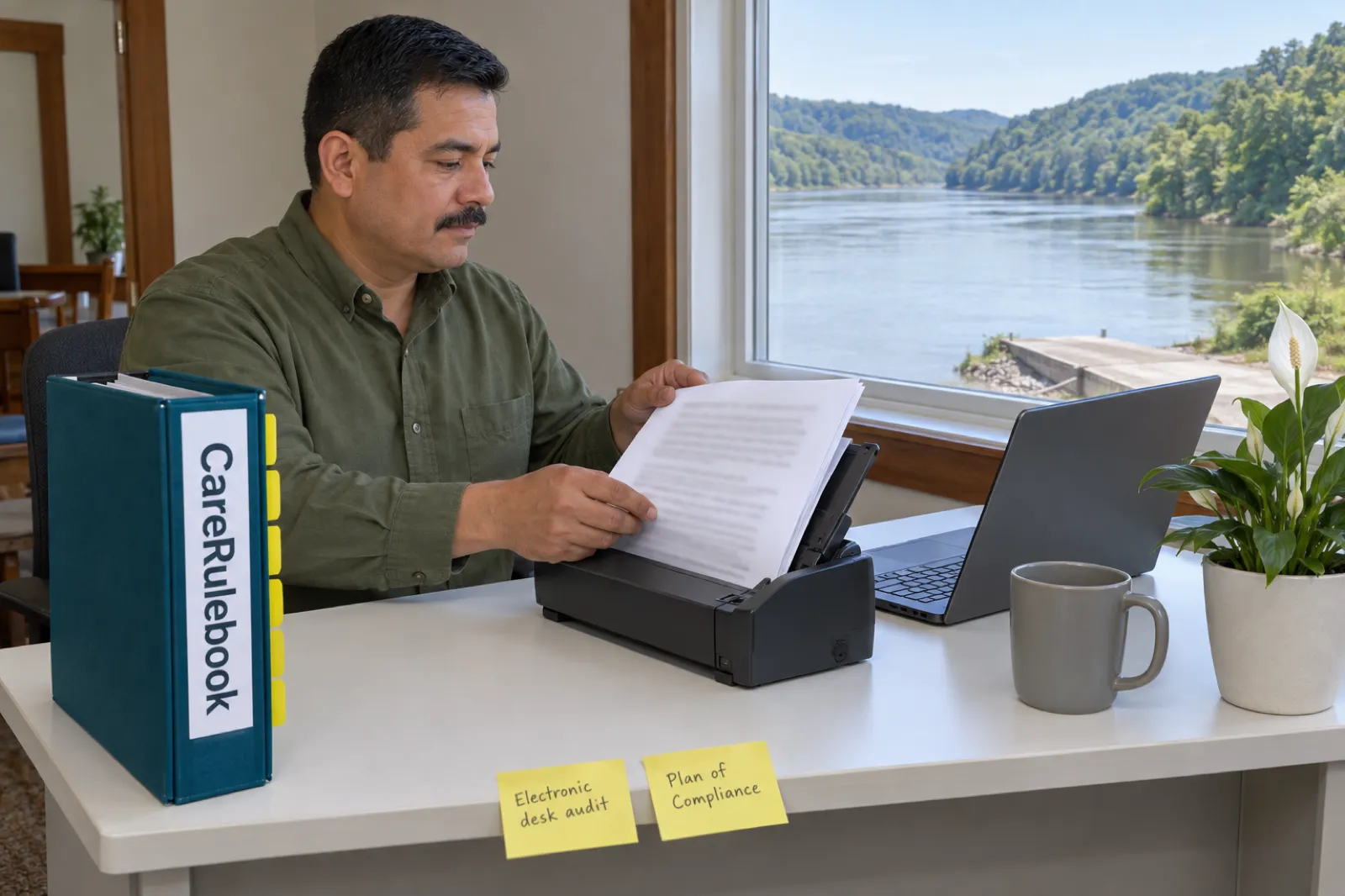
A man in an olive-green shirt feeds printed pages into a small desktop scanner beside a laptop, a CareRulebook binder and two sticky notes reading Electronic desk audit and Plan of Compliance, with a wide river and wooded ridges outside the window

Quick answer

Before your first license, TDMHSAS checks your agency by electronic desk audit: "Initial inspections for Personal Support Services Agencies (PSSAs), D.U.I. Schools, and Non-Residential Office-Based Opiate Treatment offices (OBOTs) are conducted via an electronic desk audit." TDMHSAS, step 5 It says initial inspections generally cover certain policies and procedures, and it does not publish which ones. Deficiencies are corrected before a license is issued. 0940-05-02-.06(5)(b)

After licensing, "The Department shall make at least one (1) unannounced inspection of each licensed facility/service yearly." 0940-05-02-.22 TDMHSAS may also enter, interview clients and copy records with or without notice. 0940-05-02-.13 If it finds non-compliance, you answer its Notice of Non-Compliance with a written Plan of Compliance by the date on the notice. 0940-05-02-.21 A rewrite proposed in September 2026 would allow remote unannounced inspections for services without an in-person site, which by our reading includes a PSSA; it is not in force. Proposed 0940-05-02-.22
TDMHSAS inspections

Who inspects
TDMHSAS Office of LicensureTDMHSAS, Licensing
Before the license
Electronic desk audit; no fire or life safety inspectionBecome a Licensed Provider, steps 4-5
After licensing
At least one unannounced inspection a year0940-05-02-.22
Plan of Compliance
By the date on the Notice of Non-Compliance0940-05-02-.21(2)
Extra inspection
Up to $50 (TDMHSAS’s fee)0940-05-02-.23(1)

Checked against official sources on October 2, 2026.

Desk audit

How TDMHSAS does the initial inspection for a PSSA

Become a Licensed Provider, step 5

1 a year

Unannounced inspections, at least, of each licensed service

0940-05-02-.22

11

Rule items on TDMHSAS’s list of common PSSA deficiencies

PSSA slides, slides 12-16

$250 to $5,000

TDMHSAS civil penalty per violation, per day

0940-05-02-.25(4)

The desk audit before your first license

The rule: "Upon receipt of the completed application and the required fees, the Department will arrange for needed inspections of the proposed site or sites, when applicable." 0940-05-02-.06(4) TDMHSAS’s process page describes the general next step: "When all paperwork is received, licensing fee has been paid, and life safety inspection has been conducted, if applicable, you will be contacted by the Office of Licensure regarding a date for an on-site inspection by a Licensure surveyor." But for a PSSA it adds that initial inspections are conducted via an electronic desk audit, and that PSSAs currently do not require a life safety or fire inspection. TDMHSAS, steps 4-5

What it covers. TDMHSAS says: "Generally (with a few exceptions), life safety and environment/ancillary services are inspected as well as certain policies and procedures." TDMHSAS, What does an Initial Inspection cover? Since a PSSA has no life safety inspection, by our reading the desk audit is mostly about your written policies and procedures.

Where TDMHSAS is silent. We found no TDMHSAS desk audit checklist, no list of the policies it reads, no statement of the format it wants, and nothing on whether it expects personnel files for staff hired before licensing. Neither the rules nor TDMHSAS’s pages give a time from application to desk audit or from desk audit to license. TDMHSAS, step 5

The outcome. TDMHSAS reviews the application, makes any investigations needed and reviews any inspection results. "If the review indicates compliance with all requirements for an initial license, the initial license will be issued." 0940-05-02-.06(5)(a) If it finds deficiencies, you are notified and correct them before a license is issued. 0940-05-02-.06(5)(b) The initial license lasts no more than 12 months, while TDMHSAS evaluates how you put the program rules in place. 0940-05-02-.02(1)

  1. Forms and fee received

    Day 0

    When TDMHSAS has your completed application and its $810 fee, it arranges any inspections needed.

    0940-05-02-.06(4)
  2. No fire or life safety inspection

    A residential service, or one where clients come to your place of business, needs a fire or life safety inspection at this point. TDMHSAS says PSSAs currently do not need one.

  3. The electronic desk audit

    After the fee

    For other services, TDMHSAS then arranges an on-site inspection by a Licensure surveyor. For a PSSA, the initial inspection is an electronic desk audit, which TDMHSAS says generally covers certain policies and procedures.

  4. Deficiencies corrected first

    If the review finds deficiencies, TDMHSAS tells you and you correct them before a license is issued. TDMHSAS may allow a reasonable time to correct deficiencies found by inspection.

  5. The initial license

    After any corrections

    If the review shows compliance with all requirements, TDMHSAS issues an initial license for up to one year. Only then may services begin.

  6. If TDMHSAS denies the application

    You may file a written request for a hearing before the Licensure Review Panel within 15 calendar days of the notice of denial.

    0940-05-02-.06(5)(c)

Every licensing step, from the forms to the license →

Getting ready for the desk audit

Our practical suggestions, not rule text. Each card links the source it helps you meet and the CareRulebook manual policy that covers it.

Send every policy, with an index

TDMHSAS does not publish which policies the desk audit reads, so have all of them written and adopted, with an index that shows where each of the 17 policy items and 8 personnel topics is met.

0940-05-38-.06(1), .07(2)Manual: Policy 1.2

Check the common deficiencies first

TDMHSAS publishes a list of common PSSA rule deficiencies (listed below). Check each one in your policies and forms before you send anything.

PSSA slides, slides 12-16Manual: Policy 1.5

Have the client forms ready to use

The consumer notice, rights acknowledgement, emergency contact, medication assistance authorization and semi-annual evaluation form are client record items on the common deficiency list. Blank versions show the surveyor what each client will get.

0940-05-38-.09(1)Manual: Policy 5.1

Build files for anyone already hired

Criminal background check results back before any client contact, Abuse Registry and Sex Offender Registry checks, references, work history, competency in the seven areas and the worker notice.

0940-05-38-.07(1); PSSA slide 34Manual: Policy 4.4

Ask the Regional Manager what to send

TDMHSAS says a Regional Manager can explain the next steps. Ask which policies and records the desk audit will look at, and in what format.

Become a Licensed ProviderManual: Policy 1.5

Start a compliance file now

Keep the most recent Plans of Compliance in one central place, as the rule requires, with each Notice of Non-Compliance and the evidence of each correction.

0940-05-02-.21(5)Manual: Policy 1.5

The written policies themselves, item by item, are on the Tennessee guide.

Unannounced inspections after licensing

  • At least once a year. "The Department shall make at least one (1) unannounced inspection of each licensed facility/service yearly." 0940-05-02-.22 The renewal rule adds: "Dates for unannounced inspections will be random varying from year to year." 0940-05-02-.07(4)
  • With or without notice. TDMHSAS representatives may enter and inspect with or without notice, talk to clients and other third parties, and review and copy all records needed to check compliance. 0940-05-02-.13 You must "comply with all reasonable requests of the Department and allow it to obtain information from third parties, including, but not limited to, individuals being served by the facility or service". 0940-05-02-.13 One of the 17 required policies covers licensure staff’s access to your workers, and another your cooperation with TDMHSAS’s abuse investigations. 0940-05-38-.06(1)(k), (p)
  • Who comes. TDMHSAS’s Office of Licensure "Conducts unannounced inspections and follow-ups of licensed facilities and services". TDMHSAS, Licensing Its PSSA slides refer to an agency’s assigned TDMHSAS surveyor. PSSA slides, slide 22
  • The method. The rule in force does not say whether the yearly inspection is on site, by desk review or remote. A proposal would allow remote inspections (below).
  • Extra inspections cost a fee. TDMHSAS may charge up to $50 for an onsite inspection other than the initial or annual inspection. This is TDMHSAS’s fee, not a CareRulebook price, invoiced and due within 30 days. 0940-05-02-.23

At renewal: full or provisional

Before a license expires, TDMHSAS tells you what to send for renewal, with its fee by invoice. 0940-05-02-.07(1)-(2) At renewal TDMHSAS reviews the service’s program performance history (and life safety conditions where they apply), and says dates for unannounced inspections are random and vary from year to year. 0940-05-02-.07(4) At renewal TDMHSAS issues a full license if all the licensee’s services comply. If not, it may issue a provisional license covering the service not in full compliance, or deny the renewal, which can be appealed in writing within 15 calendar days. 0940-05-02-.07(5) A provisional license calls for, among other things, a diligent effort to comply, no danger to clients, an acceptable compliance plan, and having substantially met the previous year’s plan, if any. 0940-05-02-.02(3)

The rules do not say what moves an agency from its initial license to a full license (the first unannounced inspection, the renewal review or a minimum number of clients). By our reading it is the renewal review under 0940-05-02-.07(5); ask your Regional Manager.

Complaints, incidents and investigations

"The Department will investigate reports or suspicion of abuse, dereliction, or deficiency in the operation of a licensed service or facility." 0940-05-02-.20(1) The Office of Licensure investigates licensed and unlicensed providers after reports of inadequate care or rule violations. TDMHSAS, Licensing

  • Complaints come in two ways. The public can call TDMHSAS’s complaint line, 866-797-9470. TDMHSAS, Provider FAQs You must post a sign with TDMHSAS’s toll-free number telling clients, families and the public they may complain to it. 0940-05-02-.20(2)
  • Your own reports. You report serious allegations or suspicion of abuse, dereliction or deficiency to TDMHSAS, 0940-05-02-.20(3) and TDMHSAS asks for its Reportable Incident Form by the close of the next business day. TDMHSAS Incident Reporting Requirements
  • Missed visits. TDMHSAS says it is not appropriate for care coverage to fall back on the client. If a caregiver calls in and the visit is not covered, the agency may be substantiated for not carrying out its back-up plan, and the supervisor who knew may be individually substantiated. PSSA slides, slide 31 TDMHSAS says that when a caregiver is a no-call no-show, its Notice of Non-Compliance still substantiates the agency, but the citation is worded so that the act falls on the caregiver. PSSA slides, slide 31
  • What TDMHSAS asks for. For missed visits: whether it was a no-call no-show, how you learned of it, your back-up staffing policy and the client’s alternate staffing plan. TDMHSAS PSSA reporting documentation For thefts: the hiring-time criminal background, abuse registry and sex offender checks of the staff involved. TDMHSAS PSSA reporting documentation

Reporting abuse to Adult Protective Services and child abuse to the Department of Children’s Services is separate; see abuse and incident reporting on the guide.

TDMHSAS’s common PSSA deficiencies

TDMHSAS’s PSSA slides list its common PSSA rule deficiencies. PSSA slides, slides 12-16 It also says "an agency should only be cited for violation of policy rules that are listed in the applicable administrative rules for the agency." PSSA slides, slide 38

RuleWhat it requires
0940-05-38-.09(1)(n)

Medication assistance authorization in the record

Written authorization from the client or authorized representative if the agency gives medication assistance. TDMHSAS lists it first among common deficiencies.

0940-05-38-.06(1)(n)

Hoyer lifts and gait belts

Policies on using devices such as a Hoyer lift or gait belt, after training, for transfers into or out of bed, chair, toilet or shower, but not as therapy. Required for every agency, and on TDMHSAS’s list of common PSSA deficiencies.

0940-05-38-.09(1)(p)

Consumer notice before services

A written consumer notice given before services start: the duties, responsibilities, obligations and legal liabilities of the agency, worker and client, the agency’s role as employer or contractor, and the client’s responsibility (if any) for supervising, assigning duties, hiring, firing and discipline, equipment, background checks, references and credentials.

0940-05-38-.06(1)(e)

Statement of rights and grievance procedure

A statement of the client rights in 0940-05-38-.10 and the grievance procedure for reported suspected rights violations.

0940-05-38-.09(1)(o)

Client evaluation of quality every six months

The agency develops an evaluation form; the client or legal representative evaluates service quality at least every six months and signs it.

0940-05-38-.09(1)(e)

Rights acknowledgement

Written acknowledgement that the client or legal representative was told the client’s rights and responsibilities and the agency’s rules affecting clients.

0940-05-38-.08(1)(b)

RN-supervised medication assistance training

Workers who give medication assistance get documented training by, or under the general supervision of, a registered nurse, consistent with T.C.A. 63-7-102.

0940-05-38-.09(1)(c)

Emergency contact

Name, address and telephone number of an emergency contact.

0940-05-38-.06(1)(p)

Cooperation with TDMHSAS investigations

A policy that the agency will cooperate with TDMHSAS investigating alleged abuse, neglect, mistreatment, misappropriation or exploitation.

0940-05-38-.07(1)(g)

Annual performance evaluations

Annual performance evaluations that at least assess the worker’s ability to give daily supports to clients.

0940-05-38-.08(1)(a)

Basic competency in seven areas before work

Ensure and document that workers show basic competency before working with clients in: observing, reporting and documenting changes; abuse, neglect and exploitation; client rights; universal precautions and infection control; personal hygiene help; client safety; and emergency and disaster procedures (including emergency transportation, emergency medical care and staff coverage).

Five of the eleven are client record items, so by our reading a new agency should show the forms it will use for them at the desk audit. The medication assistance items apply only if you offer medication assistance. All 17 policy items and 8 personnel topics →

Notices of Non-Compliance and Plans of Compliance

Every TDMHSAS finding follows the same path, whether it came from an inspection or an investigation. 0940-05-02-.21

StepWhat the rule saysSource
Notice of Non-ComplianceGiven on TDMHSAS’s own form when an inspection or investigation finds non-compliance with licensure law or rules.0940-05-02-.21(1)
Your Plan of ComplianceWritten, and sent by the date specified on the Notice. The rule sets no fixed number of days.0940-05-02-.21(2)
What it containsThe action taken or to be taken to correct each deficiency, and the date each corrective action is or will be completed.0940-05-02-.21(3)
TDMHSAS’s answerIn writing: whether the plan is acceptable, and why.0940-05-02-.21(4)
If it is not acceptableTDMHSAS and the licensee may keep working toward agreement. If none is reached in a reasonable time, as TDMHSAS decides, it may impose sanctions.0940-05-02-.21(4)
Time to correctTDMHSAS may allow a reasonable time to correct deficiencies found by inspection.0940-05-02-.11
Keeping copiesCopies of the most recent compliance plans kept in a central location.0940-05-02-.21(5)

Our suggestions. Note the due date the day the notice arrives, since the rule gives no standard period. Write one line per deficiency, with what you did or will do and a real date, and keep the evidence of each correction with the plan. If the date is too tight, ask TDMHSAS before it passes. The rules let TDMHSAS allow a reasonable time to correct deficiencies, but say nothing about extending the date for the plan itself. Under the proposed rewrite, a license could not be renewed while any Plan of Compliance is overdue. Proposed 0940-05-02-.07(6)

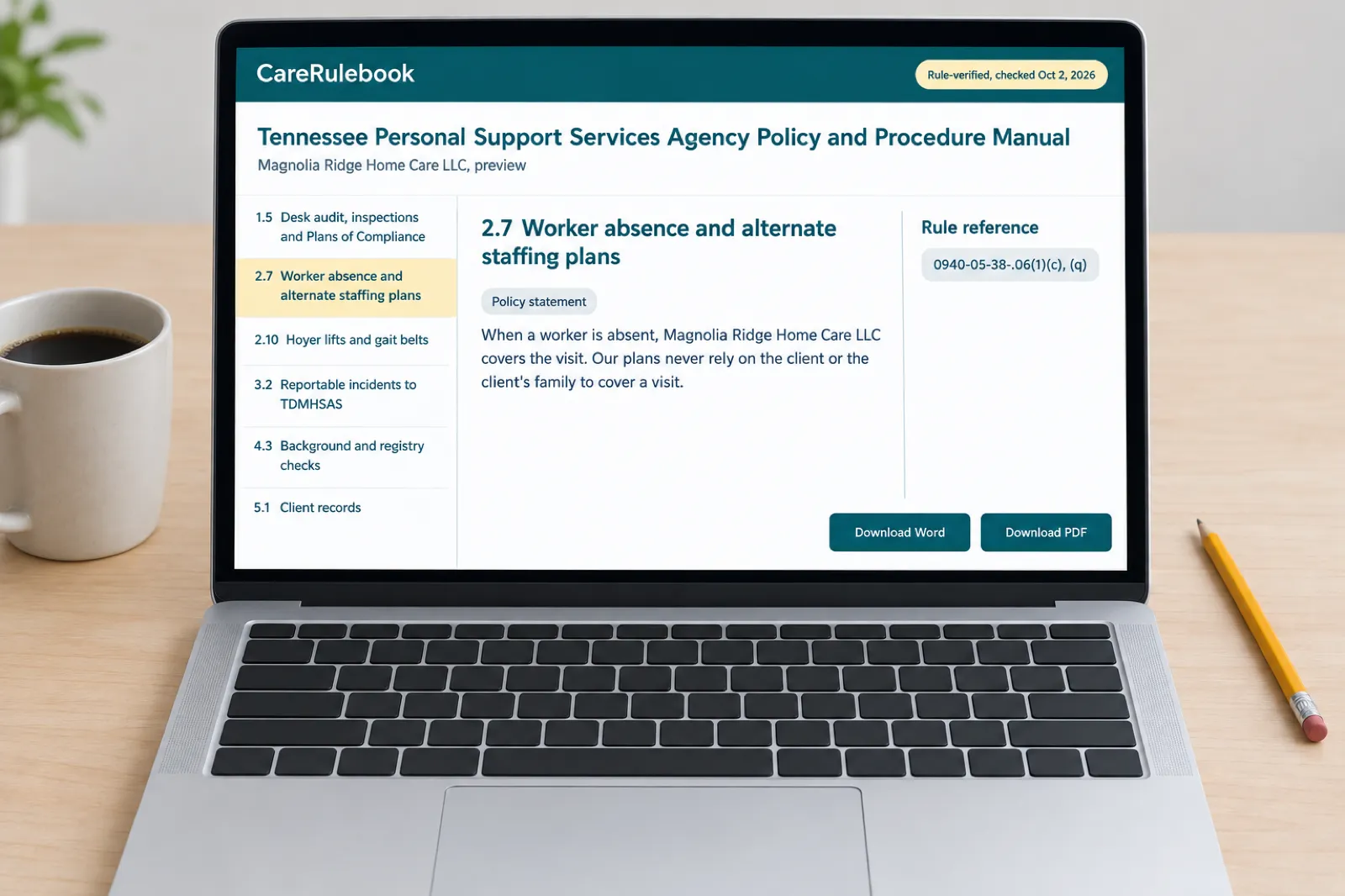
The CareRulebook Tennessee manual preview on a laptop: policy 2.7 on worker absence and alternate staffing plans for a sample agency, citing 0940-05-38-.06(1)(c), (q), with the manual’s contents listed beside it

CareRulebook

A written process for every TDMHSAS inspection

CareRulebook’s Tennessee manual includes Policy 1.5, Desk audit, inspections and Plans of Compliance: getting ready for the desk audit and unannounced inspections, giving TDMHSAS access, and answering a Notice of Non-Compliance, with an inspection-day checklist, an inspection log and a Plan of Compliance worksheet. Every other policy the PSSA rules list comes with it.

  • 32 policies, 107 requirements mapped to 0940-05-38, 0940-05-02 and 0940-05-06
  • A crosswalk of the 17 policy items and 8 personnel topics for the desk audit
  • Editable Word and print-ready PDF, with the rule quoted under each policy
Preview your manual

$199CareRulebook founding price for the first 50 Tennessee agencies, then $249. Not a TDMHSAS fee.

Civil penalties and other enforcement

A Plan of Compliance is the usual answer to a finding. For completeness, here is what the rules allow beyond it. TDMHSAS may impose a civil penalty in addition to, or instead of, other disciplinary action. 0940-05-02-.25(1)

Civil penalties

Per violation, per day: $500 for a first Priority 1 or critical offense and $250 for other first offenses; for a second offense of the same type within 12 months, $2,500 to $5,000 (Priority 1 or critical) or $500 to $2,500 (other offenses). These are TDMHSAS’s penalties, not CareRulebook charges.

0940-05-02-.25(4)

Priority 1 and critical offenses

A Priority 1 offense is a substantiated investigation involving a client’s death, neglect or physical or sexual abuse by the licensee or staff, or serious injury. A critical offense is a breach of a rule TDMHSAS has designated as one whose violation could result in serious harm to the client.

0940-05-02-.25(6)

How a penalty is imposed

Today TDMHSAS staff first tell the licensee verbally that a civil penalty may be imposed; within six business days the licensee is told in writing the basis and amount. The penalty runs from the date of the written decision, and may be imposed for each day the violation continues.

0940-05-02-.25(2)

What sets the amount

In setting a daily penalty the commissioner may consider the severity of the violation and the harm or risk of harm, willfulness, the circumstances, the efforts made to comply, extraordinary enforcement costs, the public interest and whether the penalty will deter. TDMHSAS may keep working with a licensee to reach compliance, and may waive a penalty that would cause hardship where strict enforcement would not be in clients’ best interest.

0940-05-02-.25(3), (5)

Denial, suspension and revocation

Keeping and renewing a license depends on evidence of continued compliance with licensure laws and rules. Grounds include violating licensure law or rules, conduct harmful to clients, false information to TDMHSAS, and subterfuge such as reapplying through a second party after a denial. Revocations, suspensions and denials follow the Uniform Administrative Procedures Act. Summary suspension is only for an immediate threat to clients’ health, safety and welfare.

0940-05-02-.14

Unpaid fees

Inspection fees are invoiced and due within 30 days, or before the license expires if sooner. TDMHSAS may withhold or suspend a license until its fees are paid.

0940-05-02-.23(2)-(3)

Clients if a license ends

When a license is to be denied, suspended or revoked, TDMHSAS notifies state and local agencies that may help clients by coordinating placement.

0940-05-02-.24

Operating without a license is separate: providing personal support services without one is unlawful and may bring civil or criminal sanctions. 0940-05-02-.03(1) The rules do not list which rules TDMHSAS has designated as critical.

Proposed · not in force · hearing November 18, 2026 · comments by December 4, 2026

What the proposed rewrite would change for inspections

On September 24, 2026, TDMHSAS filed proposed amendments rewriting every rule in Chapter 0940-05-02. Notice 09-31-26 The parts that touch inspections:

  • Remote unannounced inspections. For a service that does not deliver services in person at its licensed location, "then the Department may satisfy the annual unannounced inspection requirement through an unannounced remote inspection." A remote inspection would use video, telephone, secure document submission, record and policy review, personnel file and client record review, and staff and client interviews. Proposed .22(3)-(4) The proposed rule says remote inspections do not remove the yearly inspection or TDMHSAS’s power to inspect on site, investigate complaints or follow up. Proposed .22(5) By our reading a PSSA, which serves clients in their homes, is such a service; TDMHSAS has not said so.
  • Review before the initial license, in the rule. TDMHSAS "may review policies, procedures, personnel files, service recipient records, attestations, accreditation, certification, virtual review materials, or other documentation sufficient to determine compliance" Proposed .06(5) By our reading this puts what the desk audit already does into the rule, and adds personnel files and client records to the list.
  • Life safety only for in-person sites. The proposal would say life safety and environmental inspections apply when the applicant has a physical site where services are delivered in person, unless the category rules say otherwise. Proposed .06(4)
  • Records in an approved format. Services without life safety rules give TDMHSAS access, in a format it approves, to records, policies, personnel files, client records, incident reports, quality assurance materials, staff, contractors and clients. Proposed .13(2)
  • License types. The proposal would issue a full license when the licensee shows substantial compliance (today: compliance with all applicable laws and rules), and a provisional license for up to 12 months, with the same force as a full license but showing recent compliance issues. Proposed .02(2)-(3) The proposal adds that a site gets an initial license whenever TDMHSAS has been unable to verify its programmatic compliance. Under the proposal, a site that has served no clients in its licensed category since its last license would renew to another initial license. Proposed .02(1), .07(5)(c)
  • Overdue Plans of Compliance. "A site’s license may not be issued for renewal if there are any overdue Plans of Compliance." Proposed .07(6)
  • Fees before the initial inspection. The proposal keeps the $810 one-category fee, adds that fees follow an invoice, and says an initial inspection will not be scheduled until fees are paid. Proposed .05
  • Civil penalty notice in writing. Staff would notify a licensee in writing (not verbally) that a civil penalty may be imposed. Amounts unchanged. Proposed .25(2)(a)
  • Incidents within 48 hours. The proposal would require reportable incidents to reach TDMHSAS as soon as possible and within 48 hours, and says reporting only to other agencies or police does not count. Proposed .20(4)

The Plan of Compliance rule itself (.21) and the penalty amounts are unchanged in the proposal. Notice 09-31-26

What it means for a new agency, by our reading. Prepare for the desk audit as if personnel files and client records may be asked for, keep records where you can share them securely and quickly, and treat every Plan of Compliance deadline as firm.

To comment: Attend the hearing on November 18, 2026, 10:00 a.m. Central, Ground Floor Hearing Room, Andrew Jackson Building, 500 Deaderick Street, Nashville (sign up to speak at the start; state-issued ID needed), or email written comments to Krysten.Velloff@tn.gov by 4:30 p.m. CDT on Friday, December 4, 2026. Contact: Krysten Velloff, 615-881-5280.

All Tennessee rule changes →Rule change tracker

Accreditation and waivers

Accreditation is optional. Accreditation is not needed for a license; it may support "deemed" compliance with some program rules. MH-4385, item 10 A service accredited by a listed body (such as the Joint Commission or CARF) may be deemed by TDMHSAS to comply with program requirements, after sending official evidence including any cited deficiencies with the plan of correction. Deemed status does not remove the duty to correct deficiencies cited at unannounced inspections or to cooperate with investigations. 0940-05-02-.12 By our reading, deemed status would not replace the yearly unannounced inspection.

Waivers. TDMHSAS may waive an irrelevant rule or one posing a hardship, only when strict enforcement would not be in clients’ best interest; waivers are written and reviewed by the Licensure Review Panel. 0940-05-02-.19

Myths about TDMHSAS inspections

Will a TDMHSAS surveyor visit my office before my PSSA is licensed?

No. Not by TDMHSAS’s description. For other services it arranges an on-site inspection by a Licensure surveyor, but it says initial inspections for PSSAs are done as an electronic desk audit, and PSSAs currently need no life safety or fire inspection. Once you are licensed, TDMHSAS may enter with or without notice, and must make at least one unannounced inspection a year.

"Initial inspections for Personal Support Services Agencies (PSSAs), D.U.I. Schools, and Non-Residential Office-Based Opiate Treatment offices (OBOTs) are conducted via an electronic desk audit."

Will TDMHSAS tell me when my yearly inspection is?

No. The yearly inspection is unannounced, and the rule says dates for unannounced inspections are random and vary from year to year. TDMHSAS may also enter and review records with or without notice at any time. Keep records, policies and personnel files ready all year.

"Dates for unannounced inspections will be random varying from year to year."

Does TDMHSAS give a fixed number of days to send a Plan of Compliance?

No. The rule sets no fixed number of days. You send a written Plan of Compliance by the date specified on the Notice of Non-Compliance, describing each corrective action and the date it was or will be completed. Read the date on the notice as soon as it arrives.

"The licensee must submit, by the date specified on the Notice of Non-Compliance, a written Plan of Compliance in response to the Notice of Non-Compliance."

Can TDMHSAS cite my agency for missing a policy the rules don’t require?

No. TDMHSAS says it should not: an agency should only be cited for policy rules listed in its applicable administrative rules. For a PSSA that means the 17 items in 0940-05-38-.06(1), the eight personnel-policy topics in .07(2), and the other written duties in 0940-05-38, 0940-05-02 and 0940-05-06-.03(1)-(6).

"No, an agency should only be cited for violation of policy rules that are listed in the applicable administrative rules for the agency."

Frequently asked questions

Does TDMHSAS inspect a new PSSA before licensing it?

Yes, by electronic desk audit. TDMHSAS says that once the paperwork is in and the fee is paid, the initial inspection for a Personal Support Services Agency is done as an electronic desk audit, and that initial inspections generally cover certain policies and procedures. PSSAs currently need no life safety or fire inspection. If the review finds deficiencies, you are told and must correct them before a license is issued.

Which policies does the TDMHSAS desk audit look at?

TDMHSAS does not publish a list or a desk audit checklist. It says initial inspections generally cover life safety and environment and ancillary services as well as certain policies and procedures, and that a Regional Manager can explain the next steps. Our suggestion: have every policy the rules list written and adopted, with an index that shows where each of the 17 policy items and 8 personnel topics is met, and ask your Regional Manager what to send.

How often does TDMHSAS inspect a licensed PSSA?

At least once a year, unannounced. The rule says dates for unannounced inspections are random and vary from year to year, and TDMHSAS staff may enter, talk to clients and others, and review and copy records with or without notice. TDMHSAS also investigates reports of abuse, dereliction or deficiency. A proposed rewrite of the licensing procedure rules would let TDMHSAS do the yearly inspection remotely for services without an in-person site.

What is a Plan of Compliance?

Your written answer to a Notice of Non-Compliance, which TDMHSAS gives when an inspection or investigation finds a breach of licensure law or rules. The plan describes the action taken or to be taken to correct each deficiency and the date each will be completed, and is due by the date specified on the notice. TDMHSAS tells you in writing whether it is acceptable. Keep copies of the most recent plans in a central location.

Can TDMHSAS fine a personal support services agency?

Yes. TDMHSAS may impose a civil penalty for each violation, for each day it continues: $500 for a first Priority 1 or critical offense and $250 for other first offenses, rising to $2,500 to $5,000 (Priority 1 or critical) or $500 to $2,500 (other offenses) for a second offense of the same type within 12 months. These are TDMHSAS’s penalties, not CareRulebook charges. TDMHSAS may also keep working with a licensee toward compliance, and may waive a penalty that would cause hardship.

Will my yearly TDMHSAS inspection be done by video?

The rule in force says only that TDMHSAS makes at least one unannounced inspection a year. The proposed rewrite, with a hearing on November 18, 2026, would let TDMHSAS meet that requirement with an unannounced remote inspection (video, telephone, secure document submission, record and policy review, interviews) for services that do not deliver services in person at their licensed location, which by our reading includes a PSSA. It would not stop TDMHSAS inspecting on site. It is a proposal, not in force.

Does the CareRulebook manual cover TDMHSAS inspections?

Yes. Policy 1.5, Desk audit, inspections and Plans of Compliance, covers preparing for the desk audit and for unannounced inspections, giving TDMHSAS access to records and clients, answering a Notice of Non-Compliance with a Plan of Compliance, and keeping compliance plans, with an inspection-day checklist, an inspection log and a Plan of Compliance worksheet. Policy 1.2 adds a crosswalk of the 17 policy items and 8 personnel topics to send with the manual.

Get Tennessee rule-change alerts

TDMHSAS has proposed a rewrite of its licensure procedure rules, Chapter 0940-05-02, including remote unannounced inspections (hearing November 18, 2026). Leave your email and we will tell you when a Tennessee change affects your inspections or your policies.

No spam. Only emails about Tennessee home care rule changes. How we use your email.

Keep reading

Sources

  1. Tenn. Comp. R. & Regs. 0940-05-38, Minimum Program Requirements for Personal Support Services Agencies (rules effective June 2, 2016; December 2022 revised edition) · Tennessee Secretary of State, Publications Division (TDMHSAS rules) · retrieved October 1, 2026
  2. Tenn. Comp. R. & Regs. 0940-05-02, Licensure Administration and Procedures (December 2022 revised edition) · Tennessee Secretary of State, Publications Division (TDMHSAS rules) · retrieved October 1, 2026
  3. Notice of Rulemaking Hearing 09-31-26: TDMHSAS amendments to Chapter 0940-05-02, Licensure Administration and Procedures (filed September 24, 2026; hearing November 18, 2026) · Tennessee Secretary of State; Tennessee Department of Mental Health and Substance Abuse Services · retrieved October 1, 2026
  4. Become a Licensed Provider · Tennessee Department of Mental Health and Substance Abuse Services, Office of Licensure · retrieved October 1, 2026
  5. Licensed Provider Frequently Asked Questions · Tennessee Department of Mental Health and Substance Abuse Services, Office of Licensure · retrieved October 1, 2026
  6. Licensing (Office of Licensure) · Tennessee Department of Mental Health and Substance Abuse Services · retrieved October 2, 2026
  7. Personal Support Services Agency (PSSA) Provider Information (2025 slide deck; file modified November 2025) · Tennessee Department of Mental Health and Substance Abuse Services, Office of Licensure · retrieved October 1, 2026
  8. Initial Application for License, MH-4385 (rev. 05/15/2020) · Tennessee Department of Mental Health and Substance Abuse Services, Office of Licensure · retrieved October 2, 2026
  9. Incident Reporting Requirements · Tennessee Department of Mental Health and Substance Abuse Services, Office of Licensure · retrieved October 2, 2026
  10. Documentation Required for the Most Common Incidents Reported by Personal Support Service Agencies · Tennessee Department of Mental Health and Substance Abuse Services, Office of Licensure · retrieved October 2, 2026
Build your Tennessee manualfrom $199