Skip to content
CareRulebook
MenuClose

Where are you starting?

United StatesTexas, North Carolina, Georgia, Virginia, Indiana, Ohio, New York, Illinois, Washington, Colorado, Tennessee, Maryland, Kansas, South Carolina, Nevada
TexasManual
North CarolinaManual
GeorgiaManual
VirginiaManual
IndianaManual
OhioGuideNew YorkGuide
IllinoisManual
WashingtonManual
ColoradoManual
TennesseeManual
MarylandManual
KansasManual
South CarolinaManual
NevadaManual
All US states →
United KingdomEngland
Free toolsChecklists, calculators and templates

South Carolina · Home health vs home care · S.C. Code 44-70, 44-69; R.60-122

South Carolina home health vs home care: one non-medical license, a Certificate of Need for home health, and separate lines of business

South Carolina has one non-medical license, the In-Home Care Provider license from DPH. Home health is a different DPH license that needs a Certificate of Need first. Private duty nursing is not licensed by DPH at all, and Medicaid personal care adds an SCDHHS contract with nurse supervision. Here is where each one starts and stops, what caregivers may do with medication, and what the 2026 rule says about running more than one line of business.

  • Rule-verified October 2, 2026
  • Quoted from S.C. Code 44-70, 44-69 and R.60-122
  • With DPH, SCDHHS and CMS sources
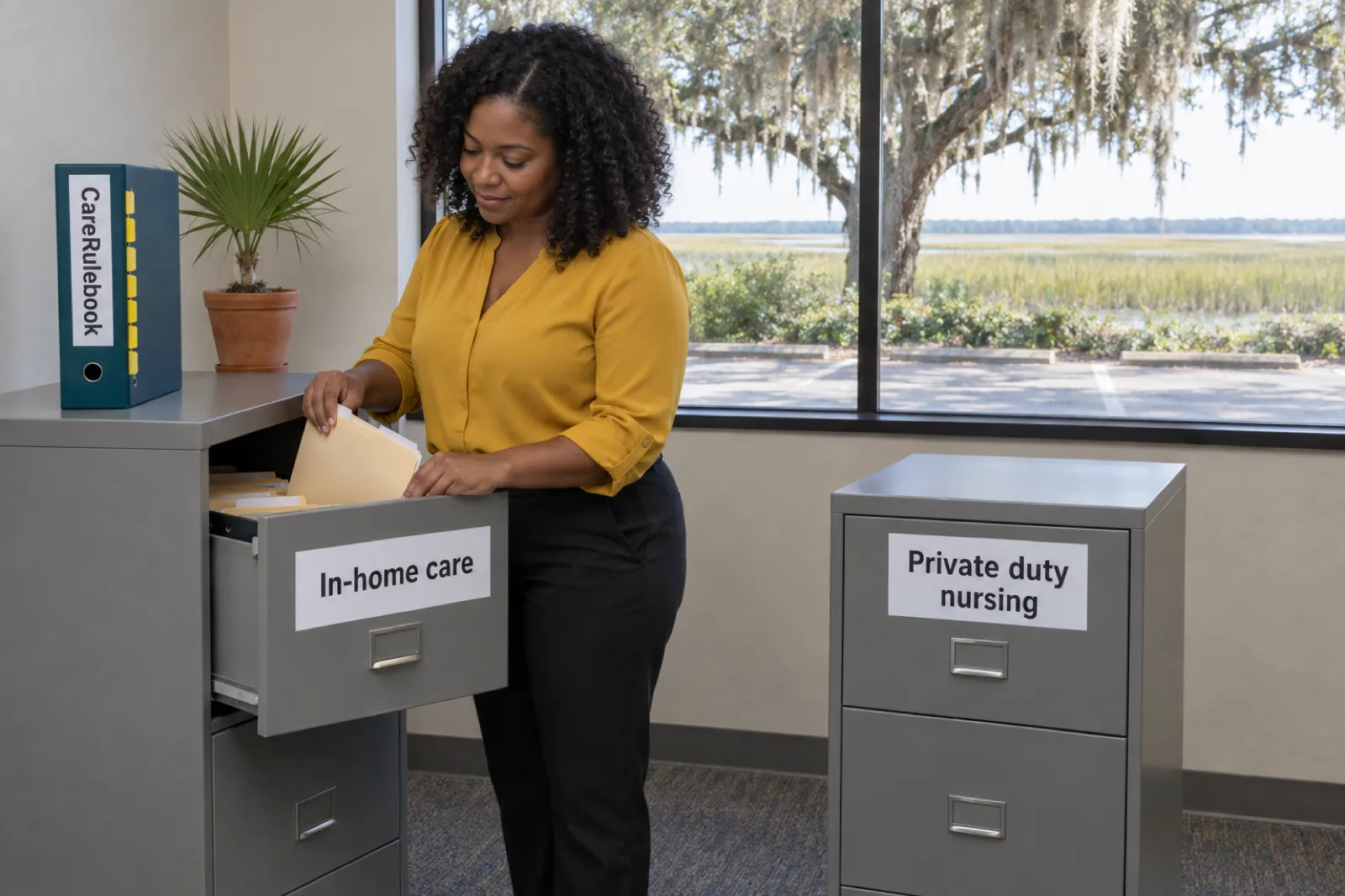
A woman filing a folder into a gray cabinet labelled In-home care, with a second cabinet labelled Private duty nursing standing apart from it and a CareRulebook binder on top of the first, and a live oak with Spanish moss and marsh grass outside the window

Quick answer

Non-medical home care in South Carolina needs an In-Home Care Provider license from DPH. In-home care is care "primarily intended to assist an individual with an activity of daily living or in meeting a personal rather than a medical need, but not including skilled care or specific therapy for an illness or injury". S.C. Code 44-70-20(2) No nurse is required. R.60-122

Home health is skilled nursing ordered by a physician, APRN or PA, plus another service, under a separate DPH license, and "A home health agency shall obtain a Certificate of Need before licensure." S.C. Code 44-69-75(A) Private duty nursing is not licensed by DPH, and an in-home care provider offering it keeps it as a separate line of business. R.60-122 §103.C.6 Medicaid personal care needs the DPH license plus an SCDHHS contract supervised by an RN or LPN. SCDHHS Personal Care Scope
Which license

Non-medical care
In-Home Care Provider license from DPHS.C. Code 44-70-30; R.60-122 §103.A
Home health
Separate DPH license, after a Certificate of NeedS.C. Code 44-69-30, 44-69-75(A)
Private duty nursing
Not licensed by DPH; a separate line of businessDHEC memo, 2015; R.60-122 §103.C.6
Medicaid personal care
The DPH license plus an SCDHHS contract with RN or LPN supervisionSCDHHS Personal Care Scope
Nurse for the DPH license
None requiredR.60-122 §401, §402.B
Medication
Reminders only, under R.60-122R.60-122 §700.B.13

Checked against official sources on October 2, 2026.

$1,000

DPH’s initial in-home care license fee (state fee)

R.60-122 §103.I

13

Non-medical care services the in-home care rule lists

R.60-122 §700.B

1 a year

Minimum inspections of a licensed home health agency

S.C. Code 44-69-70

4 months

Longest gap between Medicaid nurse supervisory visits

SCDHHS Scope, E.3.f

Four routes for care at home

In-home care provider

No one may operate, or advertise or market itself, as an in-home care provider in South Carolina without first getting a license from DPH. If DPH finds an unlicensed provider serving clients, the owner must stop at once and make sure clients are safe. R.60-122 §103.A DPH’s facility data listed 1,402 licenses on October 2, 2026. DPH Find a Facility, our count

Home health agency

No one may run a home health agency, or say they provide home health services, without first getting a home health agency license from the department. S.C. Code 44-69-30 In-home care providers do not include home health agencies or hospices. S.C. Code 44-70-20(3)(a)

Private duty nursing

DHEC’s 2015 memo describes private duty nursing as generally skilled nursing care on a full-time, continuous and long-term basis. DHEC memo, Aug 13, 2015 DPH does not license it. More below.

Medicaid personal care

Not a separate license. "Providers who are not licensed by the South Carolina Department of Public Health (SCDPH) will not be allowed to enroll as a Medicaid provider for these services." SCDHHS Scope, B.2

In-home care, home health and Medicaid personal care, side by side

In-home care providerHome health agencyMedicaid personal care
What it coversHelp with activities of daily living or personal, not medical, needs; never skilled care or therapy. 44-70-20(2)Part-time or intermittent skilled nursing ordered by a physician, APRN or PA, plus at least one other service such as therapy or home health aide services. 44-69-20(5)Personal care paid by Medicaid under an SCDHHS contract. No skilled medical service of any kind by an aide. Scope, C.5
License and lawDPH In-Home Care Provider license; S.C. Code 44-70 and R.60-122. 44-70-30; R.60-122DPH home health agency license; S.C. Code 44-69 and R.60-77. 44-69-30; DPHThe DPH In-Home Care Provider license, then SCDHHS enrollment. Scope, B.2
Before licensingNo Certificate of Need. Substantial compliance with R.60-122 shown to DPH. R.60-122 §103.BA Certificate of Need from DPH first. 44-69-75(A)An owner or administrator with three years of health care administrative experience. Scope, B.1
NurseNone required. A nurse is only one of the people who may review drug tests and self-assessments. R.60-122 §402.BSkilled nursing by or under a registered nurse; policies set by a group including a physician and an RN. 44-69-20(5)(a), 44-69-60RN or LPN supervision (may be contracted): task list before care, a visit within 30 days, then every four months. Scope, D.1, E.2-3
MedicationMedication reminders; the definition of in-home care includes supervising self-administered medication. R.60-122 §700.B.13, §102.JSkilled nursing under physician, APRN or PA orders. 44-69-20(5)(a)Monitoring medication; the aide cannot administer it but may hand the participant the container. Scope, C.6.d
InspectionsWithout prior notice; no interval set in the rule. R.60-122 §202.AAt least once a year. 44-69-70DPH inspects the license; SCDHHS sets its own contract duties. Scope
OfficeCommercially zoned or unzoned primary office. R.60-122 §103.D.1Not covered on this page (R.60-77 not saved). DPHCommercially zoned or unzoned office. Scope, B.3

We have not saved R.60-77, the home health rule, or the CON regulation, R.60-15, so this page does not cover home health staffing, fees or how a Certificate of Need is decided. If your plan includes home health, start with DPH.

The non-medical limit

"Care services provided by caregivers are strictly limited to non-medical tasks." R.60-122 §700.B The rule then lists 13 services, from meal preparation, bathing, dressing and help walking to cleaning, laundry, shopping, errands, transportation, home safety hazards, help with communication and medication reminders. R.60-122 §700.B The full list: non-medical only, on the South Carolina guide.

  • Skilled care is out. Skilled care is a service ordered by a physician or other authorized healthcare provider that "Requires the skills of technical or professional personnel such as registered nurses, licensed practical nurses, physical therapists, occupational therapists, and speech pathologists or audiologists", furnished by or under such personnel. R.60-122 §102.V In-home care excludes it. S.C. Code 44-70-20(2)(a)
  • No continuing medical supervision. In-home care is personal in nature and does not need the continuing attention or supervision of trained and licensed medical personnel. R.60-122 §102.J.3
  • Class I. Section 700 is marked (I), so caregivers doing skilled tasks would be a Class I matter by the rule’s own notation. R.60-122 §205.D Penalties: inspections and penalties.
  • A nurse on staff does not change this. The license covers non-medical care whoever gives it. By our reading, hiring a nurse lets you use them for the roles the rule names, such as reviewing drug tests and self-assessments, R.60-122 §402.B, §406.A not to give skilled care to in-home care clients.

Medication reminders: what the sources say, and what they leave open

SourceWordsCite
R.60-122 task list"Medication reminders."R.60-122 §700.B.13
Statute and rule definitionsIn-home care includes help with activities of daily living such as "supervising self-administered medications".R.60-122 §102.J.2; 44-70-20(2)(b)
SCDHHS, Medicaid only"The aide cannot administer the medicine; however, this does not preclude the aide from handing the medicine container to the participant."Personal Care Scope, C.6.d
Before May 22, 2026Medication assistance was a training topic, if applicable; the 2026 rule removed it.R.60-122 §404 change

What is not settled. R.60-122 does not say what a medication reminder includes: whether a caregiver may open a container, hand it over or fill a pill organizer. SCDHHS’s words apply to Medicaid personal care, not to the DPH license. Our reading: a private-pay in-home care provider keeps to reminding and observing, does not touch the medication, and asks DPH before allowing more. That is how Policy 5.2, Medication reminders, in the CareRulebook manual is written. We have listed the question for DPH.

Companion and homemaker only: not settled

The Act’s only service-based exemption is "an individual or agency who provides only a house cleaning service". S.C. Code 44-70-20(3)(b) The rule’s list of care services a licensed provider gives includes cleaning, laundry, shopping, errands, transportation and help with communication. R.60-122 §700.B Against that, the definition of in-home care joins its three parts with "and": care primarily to help with an activity of daily living or a personal need, given to help with an activity of daily living, and personal in nature. S.C. Code 44-70-20(2)

Our reading: a business offering only companionship and homemaker help probably needs the license, because DPH’s rule treats those services as in-home care, but the statute can be read the other way. We found no written DPH answer. Ask DPH (IHCP@dph.sc.gov) before operating without a license; no one may operate or advertise as an in-home care provider without one. R.60-122 §103.A

Private duty nursing: not licensed by DPH, kept separate

  • DHEC’s 2015 memo, still linked on DPH’s in-home care and home health pages, says an in-home care provider that also offers private duty nursing "should maintain separate lines of business between its in-home care offerings and private duty nursing offerings". DHEC memo, Aug 13, 2015 The memo predates the 2026 rule and cites the old regulation number, so we use it as guidance only.
  • Staff who only nurse. The 2015 memo says DHEC would not review the records of staff who only provide private duty nursing, because it does not regulate it. DHEC memo, Aug 13, 2015
  • Staff who do both. The 2015 memo says a staff member who provides both in-home care and private duty nursing is an in-home caregiver, and every caregiver rule applies to them. DHEC memo, Aug 13, 2015 That means the drug tests, background and registry checks, training and self-assessment that R.60-122 sets for caregivers. R.60-122 §403
  • The 2026 rule makes it a duty. "If the provider provides services or care other than in-home care services, the provider must maintain separate lines of business regarding such other services or care." "This includes, but is not limited to, maintenance of separate representations to the public regarding these businesses, separate maintenance of caregiver records, and separate maintenance of client records." R.60-122 §103.C.6

By our reading, "separate representations to the public" means separate marketing, such as separate web pages and brochures, and nothing for the nursing business suggesting it is covered by the in-home care license. The rule does not say whether the two businesses may share an office or a legal entity; ask DPH. Nurses’ own licensing, through the Board of Nursing, is outside this page.

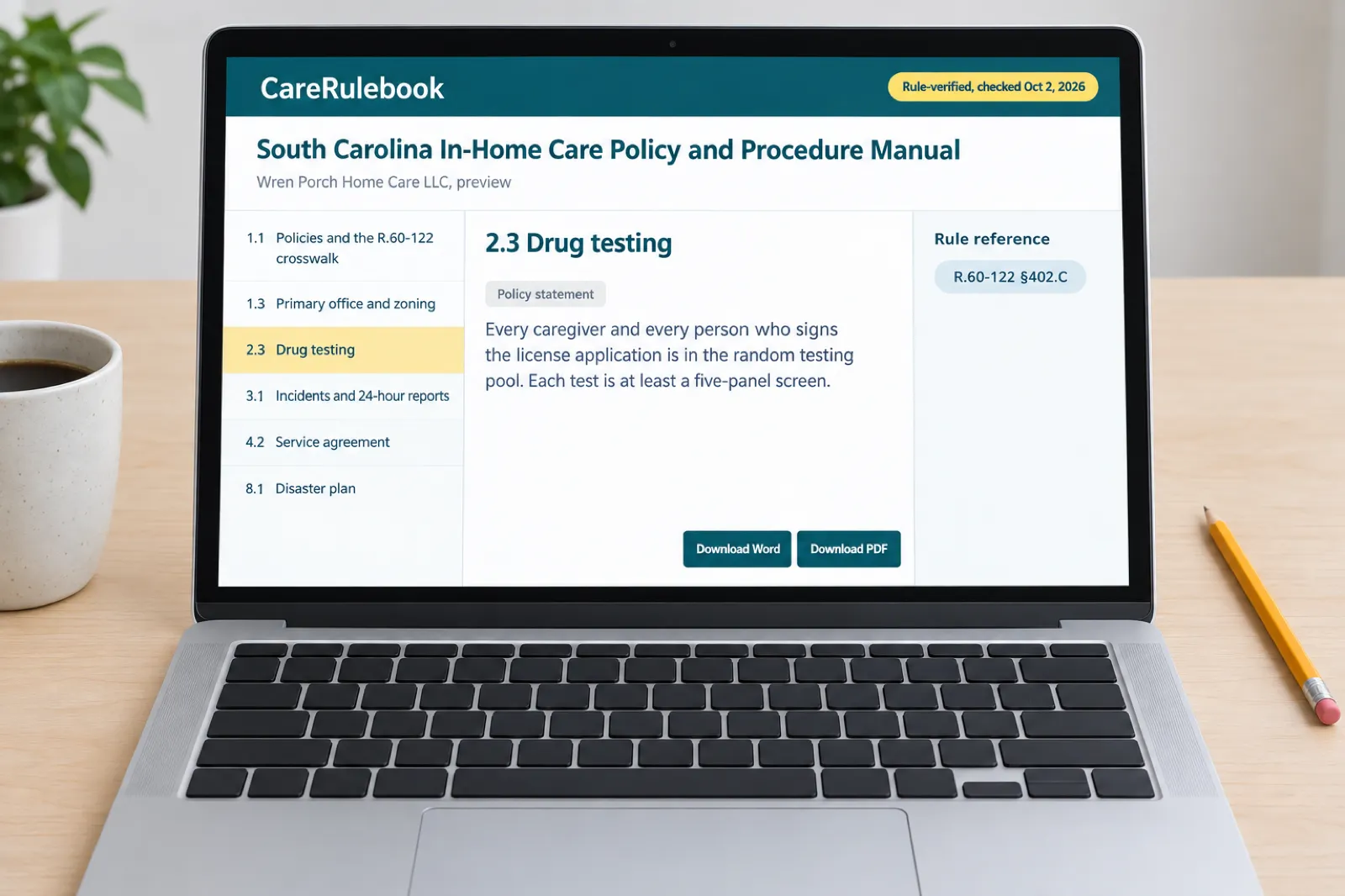
The CareRulebook South Carolina manual preview on a laptop: policy 2.3 on drug testing for a sample agency, citing R.60-122 §402.C, with six of the manual’s policies listed beside it

CareRulebook

Non-medical care, written down clearly

CareRulebook’s South Carolina manual is built for a licensed in-home care provider: Policy 5.1, Care services and the non-medical limit, with a caregiver quick guide to the 13 care services; Policy 5.2, Medication reminders, with what caregivers never do; and Policy 1.2, which covers running any other service as a separate line of business.

  • 29 policies, 84 requirements mapped to R.60-122 and S.C. Code 44-70
  • Written for the rule as rewritten on May 22, 2026, with no nursing anywhere
  • Editable Word and print-ready PDF, with the rule quoted under each policy
Preview your manual

$199CareRulebook founding price for the first 50 South Carolina agencies, then $249. Not a DPH fee.

Home health and the Certificate of Need

  • CON first. "A home health agency shall obtain a Certificate of Need before licensure." S.C. Code 44-69-75(A) The In-Home Care Providers Act has no such requirement. S.C. Code 44-70
  • Still applied in 2026. DPH’s September 2026 CON update lists a Certificate of Need approved on September 17, 2026 for establishing a new home health agency, and other home health matters under review, so DPH still applies the CON requirement to home health. DPH, CON Update, September 2026
  • The CON Act’s own list. Since 2023 Act No. 20, the CON Act’s list of projects needing a Certificate of Need names nursing homes and hospitals; the hospital part is repealed from January 1, 2027. Home health is not on that list, but the home health Act (44-69-75(A), amended in 2024) still requires a Certificate of Need before licensure. S.C. Code 44-7-160 By our reading, the home health requirement rests on 44-69-75(A) itself, and DPH’s 2026 approvals show it is applied.
  • Unsure? DPH’s CON program gives written determinations on whether the CON Act applies to a proposed facility or service; staff do not give them by phone. DPH, Certificate of Need

The home health license

  • Term. A home health agency license lasts twelve months from the date of issue, and each subunit is licensed separately. S.C. Code 44-69-30
  • Inspections. Each licensed home health agency is inspected at least once a year, including whether care follows the patient’s physician’s orders. S.C. Code 44-69-70
  • Policies. The home health regulations must require the agency’s policies to be set by a professional group that includes at least one physician and one registered nurse. S.C. Code 44-69-60
  • Services. The other services are physical, occupational or speech therapy; medical social services, home health aide services and other therapeutic services; and medical supplies and appliances. S.C. Code 44-69-20(5)
  • Unlicensed home health. Violating the home health Act is a misdemeanor, with a fine of up to $500 or up to six months in prison, or both. S.C. Code 44-69-100
  • The rule. DPH licenses home health agencies under Regulation 60-77, with its own application form (3289-ENG-DPH). We have not saved R.60-77 itself. DPH, Home Health Agencies

Medicaid personal care: the DPH license plus an SCDHHS contract

  • License first. SCDHHS requires the DPH in-home care license to enroll for Medicaid personal care; losing it ends the contract. SCDHHS Scope, B.2
  • A nurse supervisor. Personal care "must be provided under the supervision of a RN or LPN", who may be contracted. SCDHHS Scope, D.1, E.3 "For PCS, a task list must be developed by an RN or LPN Supervisor." SCDHHS Scope, E.2
  • Supervisory visits. The Medicaid nurse supervisor visits the participant’s home within 30 days after personal care starts, then at least once every four months. SCDHHS Scope, E.3.e-f
  • Experience. SCDHHS requires the owner or administrator of a Medicaid personal care agency to have at least three years of health care administrative experience. SCDHHS Scope, B.1
  • Office. SCDHHS already required Medicaid personal care agencies to be housed in a commercially zoned or unzoned office. SCDHHS Scope, B.3 R.60-122 now requires the same for every in-home care provider’s primary office. R.60-122 §103.D.1 See the administrator and office.
  • Complaints. For Medicaid personal care, the nurse supervisor tells the participant of their right to complain, with names, phone numbers and addresses; both sign. The first point of contact is someone employed by the provider, and the second is the relevant licensing agency, such as DPH. SCDHHS Scope, E.3.a.iii
  • One R.60-122 difference. "For clients receiving care services pursuant to a Medicaid program, a service agreement is not required." The care services plan, rights form and disaster plan still apply to every client. R.60-122 §601.B.2 More on each: South Carolina client paperwork.

The data DPH publishes does not say which of the licensed providers also hold Medicaid contracts. DPH Find a Facility This page and the CareRulebook manual cover the DPH license, not SCDHHS enrollment.

Federal · Medicare enrollment · from May 13, 2026

Medicare and CMS’s 2026 home health moratorium

CMS’s memo QSO-26-11: "Effective May 13, 2026, CMS will halt the enrollment of new Hospice and HHA providers or HHA branch or practice locations." QSO-26-11

  • How long. The moratorium lasts six months and can be extended for further six-month periods; any lifting or extension is announced in the Federal Register. QSO-26-11 Six months from May 13, 2026 runs to about November 13, 2026, by our arithmetic, unless CMS extends it.
  • No exceptions. CMS regulations do not allow exceptions to the moratorium for individual providers. Applications received before May 13, 2026 continue to be processed. QSO-26-11

What it means, by our reading. The memo is about Medicare enrollment of home health agencies and hospices, not state licenses, and does not mention non-medical home care. A South Carolina in-home care provider is not a Medicare home health agency, so the moratorium does not affect it. For a planned home health agency, the Certificate of Need and the DPH license come first, and Medicare enrollment of new agencies is closed while the moratorium lasts.

Which route fits your plan

Find the line closest to what you will offer. Fees are DPH’s, not CareRulebook prices. Lines marked "by our reading" are ours; check with DPH before you apply.

If you plan to offerLicenseState feeSource
Bathing, dressing, toileting, meals, help walking and transfers, medication reminders, with no skilled careIn-Home Care Provider license (DPH)$1,000, then $800 a year (DPH)R.60-122 §700.BR.60-122 §103.I
The same, billed to Medicaid personal careIn-Home Care Provider license, then SCDHHS enrollment with RN or LPN supervisionDPH’s fees; SCDHHS termsScope, B.2Scope, D.1
Only meals, laundry, shopping, errands, rides or company, with no hands-on helpNot settled; by our reading, probably the In-Home Care Provider license. Ask DPHDPH’s fees if licensed44-70-20(3)(b)R.60-122 §700.B
House cleaning onlyNo in-home care licenseNone from DPH44-70-20(3)(b)
Skilled nursing, therapy or home health aide services under physician, APRN or PA ordersHome health agency license (DPH), after a Certificate of NeedNot covered here44-69-75(A)CON update, Sept 2026
Private duty nursing alongside in-home careNo DPH license for the nursing; run it as a separate line of business from the in-home care licenseDPH’s in-home care fees onlyDHEC memo, 2015R.60-122 §103.C.6

Ready to apply for the in-home care license? Every step is on the South Carolina guide, and what DPH can check after licensing is on inspections and incidents.

Myths about home health and home care in South Carolina

Can a South Carolina in-home care provider hire a nurse and offer skilled care under the same license?

No. Care services under the in-home care license are strictly limited to non-medical tasks, and skilled care, which needs nurses or therapists, is outside in-home care. Skilled nursing ordered by a physician, APRN or PA is home health, which needs a home health agency license and a Certificate of Need. A nurse may work for an in-home care provider in other roles, such as reviewing drug tests or health self-assessments. Private duty nursing is not licensed by DPH, and the rule requires any other service to be run as a separate line of business.

"Care services provided by caregivers are strictly limited to non-medical tasks."

Does CMS’s 2026 home health moratorium stop me opening a non-medical home care agency in South Carolina?

No. By our reading, it does not. CMS’s memo halts Medicare enrollment of new home health agencies and hospices from May 13, 2026. An in-home care provider is a DPH state license for non-medical care and is not a Medicare home health agency, so the moratorium does not reach it. It matters only if you plan a Medicare-certified home health agency, which in South Carolina also needs a Certificate of Need and a home health license first.

"Effective May 13, 2026, CMS will halt the enrollment of new Hospice and HHA providers or HHA branch or practice locations."

Do I need a license in South Carolina if I only offer companionship and homemaker services?

It depends. Not settled; by our reading, probably yes. The only service-based exemption is "an individual or agency who provides only a house cleaning service", and DPH’s rule lists laundry, shopping, errands, transportation and help with communication among the care services a licensed provider gives. Against that, the statute and the rule define in-home care as care that is primarily to help with an activity of daily living or a personal need, given to help with an activity of daily living, and personal in nature, joined by "and", so a service with no help with daily living may not be in-home care at all. Ask DPH (IHCP@dph.sc.gov) before operating without a license.

"an individual or agency who provides only a house cleaning service"

Do I need a Certificate of Need to open a home care agency in South Carolina?

It depends. Not for an in-home care provider. The In-Home Care Providers Act has no CON requirement. A home health agency (skilled nursing ordered by a physician, APRN or PA, under an RN) must get a Certificate of Need before licensure.

"A home health agency shall obtain a Certificate of Need before licensure."

Can caregivers give medication in South Carolina non-medical home care?

No. Care is strictly limited to non-medical tasks, and the only medication service the rule lists is medication reminders. The definitions of in-home care in the statute and in R.60-122 §102.J also include supervising self-administered medications. Neither says caregivers may administer medication, and skilled care needs a home health agency. Whether caregivers may set up doses or fill pill organizers is not addressed; by our reading they should not, and DPH can confirm.

"Care services provided by caregivers are strictly limited to non-medical tasks."

Do I need a registered nurse to open a non-medical home care agency in South Carolina?

No. Not for the DPH license. R.60-122 requires an administrator, not a nurse, and caregivers may do only non-medical tasks. If you want to bill Medicaid personal care through SCDHHS, the agency must have RN or LPN supervision (which may be contracted). Skilled nursing needs a home health agency license and a Certificate of Need.

"Each provider shall have an administrator who is responsible for the overall management and operation of the provider."

Frequently asked questions

What is the difference between home health and home care in South Carolina?

Home care, which South Carolina calls in-home care, is non-medical help with daily living and personal needs, licensed by DPH as an In-Home Care Provider with no nurse required. Home health is part-time or intermittent skilled nursing ordered by a physician, APRN or PA, given by or under a registered nurse, plus at least one other service such as therapy or home health aide services. It is a separate DPH license under S.C. Code 44-69 and needs a Certificate of Need before licensure. In-home care excludes skilled care.

Do I need a Certificate of Need for a home care agency in South Carolina?

Not for an in-home care provider: the In-Home Care Providers Act has no Certificate of Need requirement. A home health agency must obtain one before licensure under S.C. Code 44-69-75(A), and DPH’s September 2026 CON update shows it still approving them for new home health agencies. The CON Act’s own list in 44-7-160 now names only nursing homes and hospitals, so if your plan sits near the line, ask DPH’s CON program for a written determination.

Can an in-home care provider in South Carolina give medication?

Not under R.60-122. Care is strictly limited to non-medical tasks, and the only medication service listed is medication reminders; the definition of in-home care also includes supervising self-administered medications. The rule does not say whether a caregiver may hand a client a container. SCDHHS lets Medicaid personal care aides hand the container but not administer medicine. By our reading, a private-pay agency keeps to reminders and asks DPH before going further.

Can I offer private duty nursing under my in-home care license?

No. DPH does not license private duty nursing, which DHEC’s 2015 memo describes as generally skilled nursing on a full-time, continuous and long-term basis. Since May 22, 2026, R.60-122 requires any service other than in-home care to be run as a separate line of business, with separate marketing, caregiver records and client records. DHEC’s memo also says a staff member who does both kinds of work counts as an in-home caregiver, so every caregiver rule applies to them. Nurses’ own licensing is outside this page.

Do I need a nurse to bill Medicaid for personal care in South Carolina?

Yes. The DPH license needs no nurse, but SCDHHS requires Medicaid personal care to be supervised by an RN or LPN, who may be contracted. The nurse visits the home and writes the aide’s task list before care starts, makes a supervisory visit within 30 days, then visits at least every four months. The owner or administrator also needs three years of health care administrative experience.

Does the CMS home health moratorium affect in-home care providers?

By our reading, no. CMS halted Medicare enrollment of new home health agencies and hospices nationwide from May 13, 2026, for six months that can be extended. An in-home care provider is a state license for non-medical care, not a Medicare home health agency. The moratorium matters only if you plan a Medicare-certified home health agency, which also needs a Certificate of Need in South Carolina.

Does the CareRulebook manual cover the non-medical limit?

Yes. Policy 5.1, Care services and the non-medical limit, lists the 13 care services the rule allows and what caregivers do when a client needs skilled care, Policy 5.2 sets out what a medication reminder includes and what caregivers never do, and Policy 1.2 covers keeping any other service as a separate line of business.

Get South Carolina rule-change alerts

DPH has not said in writing where medication reminders end or whether companion-only services need the license, and CMS’s home health moratorium may be extended. Leave your email and we will tell you when a South Carolina or federal change affects your license or your policies.

No spam. Only emails about South Carolina home care rule changes. How we use your email.

Keep reading

Sources

  1. Regulation 60-122, Standards for Licensing In-Home Care Providers (Document No. 5407, State Register Vol. 50, Issue 5, effective May 22, 2026, with the errata in Vol. 50, Issue 6, June 26, 2026) · South Carolina Department of Public Health; South Carolina Legislative Council (State Register) · retrieved October 2, 2026
  2. S.C. Code 44-70-10 to 44-70-80, Licensure of In-Home Care Providers Act · South Carolina Legislative Services Agency · retrieved October 2, 2026
  3. S.C. Code 44-69-10 et seq., Licensure of Home Health Agencies Act · South Carolina Legislative Services Agency · retrieved October 2, 2026
  4. In-Home Care Providers (regulations, forms, memos, map) · South Carolina Department of Public Health · retrieved October 2, 2026
  5. Distinctions between in-home care services and home health services (memo, August 13, 2015) · S.C. Department of Health and Environmental Control, Bureau of Health Facilities Licensing (linked by DPH) · retrieved October 2, 2026
  6. Find a Facility: In-Home Care Providers (licensed provider list behind DPH’s facility map, exported October 2, 2026) · South Carolina Department of Public Health · retrieved October 2, 2026
  7. HCBS Provider Manual, Scope of Services for Personal Care, HASCI Agency Attendant Care and Respite (July 1, 2025) · South Carolina Department of Health and Human Services · retrieved October 2, 2026
  8. Certificate of Need Update, September 2026 (linked from DPH’s Certificate of Need page) · South Carolina Department of Public Health · retrieved October 4, 2026
  9. Certificate of Need (CON) program page (updated Oct. 1, 2026) · South Carolina Department of Public Health · retrieved October 2, 2026
  10. Home Health Agencies (regulation, application form and memo; updated Nov. 10, 2025) · South Carolina Department of Public Health · retrieved October 2, 2026
  11. S.C. Code 44-7-160, Certificate of Need requirements (as amended by 2023 Act No. 20) · South Carolina Legislative Services Agency · retrieved October 2, 2026
  12. QSO-26-11-HHA & Hospice: Six-Month National Moratoria on Hospice and Home Health Agency Enrollment (May 20, 2026) · Centers for Medicare & Medicaid Services · retrieved September 30, 2026
Build your South Carolina manualfrom $199