1. The client signs
A client signs an informed consent form consenting to assistance by a nonlicensed individual with treatments of a routine nature, or with the self-administration of medications.
COMAR 10.07.05.08B(1)(d)(ii)Where are you starting?
Maryland · Medication · COMAR 10.07.05.12F and 10.27.11.05
In a Maryland Residential Service Agency, medication help comes in levels: reminders, help for a client who takes their own medication, and administration by licensed nurses or certified medication technicians under a registered nurse’s delegation. Each level changes who may do it, what the client signs and how often your RN visits. Here is each one, quoted from the rules, with the question the rules leave open.

Quick answer
Administration is nursing. "Administration of medication is a nursing function. As such, the nurse retains full responsibility for medication administration." (COMAR 10.27.11.05F) If your staff administer medication, it is done by licensed or certified staff, consistent with Maryland law and the plan of care, only as the physician orders, with medications, errors and adverse reactions recorded (COMAR 10.07.05.12F). A nurse may delegate it only to certified medication technicians and certified medicine aides, within the Board’s limits (COMAR 10.27.11.05H).
Helping a client who takes their own medication needs the client’s signature first: an informed consent form "consenting to assistance by a nonlicensed individual with treatments of a routine nature, or with the self-administration of medications" (COMAR 10.07.05.08B(1)(d)(ii)). Only a cognitively capable adult client, not a representative, may waive the agency’s recommendation of certified care for that help (.12D(2)).
Your RN visits more often. At least every 45 days when staff administer medication, every 3 months when they help with self-administration, and every 4 months when they do neither (.12E(2)). One question is open: the Board’s list of settings where a nurse may delegate medication administration does not name a client’s own home (see below).
45 days
Longest gap between RN on-site visits when staff administer medication
COMAR 10.07.05.12E(2)(a)The RSA rules speak of help with self-administration and administration; the Board of Nursing’s rules decide who may administer. Reminders are not named in either, so the first column is partly our reading.
| Reminders | Help with self-administration | Administration by certified staff | Licensed nurses | |
|---|---|---|---|---|
| What it is | Telling the client it is time to take their medication. The client takes it. | Help a client who takes their own medication, such as opening a container they cannot open. The rules do not define the tasks. | Giving the client medication, under a registered nurse’s delegation, within the Board’s list of routes. | Everything else, including calculating doses and most injections. |
| Who | Caregivers trained for it. OHCQ says nursing assistants without RN-supervised medication management may give reminders to clients who self-administer (OHCQ checklist). | A nonlicensed individual, with the client’s signed consent (.08B(1)(d)(ii)). | Certified medication technicians and certified medicine aides (COMAR 10.27.11.05H). | Licensed nurses (.12F(1)). |
| Paperwork | By our reading, the same consent as help with self-administration, until OHCQ says otherwise. | Signed, dated informed consent form after a risk and benefit discussion (.12D(4)). | Physician’s orders; medications, errors and reactions recorded (.12F(2)-(3)). | The same orders and records (.12F). |
| RN on site | Every 3 months by our reading; every 4 months if OHCQ treats reminders as no help. | At least every 3 months (.12E(2)(b)). | At least every 45 days (.12E(2)(a)). | At least every 45 days (.12E(2)(a)). |
The last column is our summary of what the Board keeps with nurses: "calculation of any medication dose", and injection, tube and intravenous routes except as 10.27.11.05H allows (COMAR 10.27.11.05G). We have not reviewed the Nurse Practice Act itself, so we do not describe what nurses may do.
Three rules frame every level:
OHCQ’s archived 2020 slides put it plainly: "Both waiver options never permit medication administration by Certified Nursing Assistants or unlicensed aides." (OHCQ slides, 2020). That is old guidance, but it matches the Board’s rule that only medication technicians and medicine aides may be delegated administration.
Neither is defined. COMAR 10.07.05’s definitions (.02B) do not define reminders, self-administration or what help with it includes. OHCQ’s trainer checklist says nursing assistants without medication management supervised by an RN must never administer medications, but may give reminders to clients who are self-administering (OHCQ trainer checklist).
Reminders and the RN’s interval. The 3-month interval applies "if the staff assists the client with self-administration of medications" and the 4-month interval when staff do neither (.12E(2)(b)-(c)). Which one a reminder falls under is on our list of questions for OHCQ. By our reading, treat reminders as help with self-administration until OHCQ answers: the consent form and 3-month visits cost little, and cover you either way.
What help can include. The rules leave the tasks to the agency and its RN. CareRulebook’s Policy 4.2 limits help to reminding the client, bringing the container, opening a container or organizer compartment the client cannot open, reading the label, steadying the client’s hand or holding a glass, and noting what the client said they took. The RN picks, for each client, which of those caregivers give. That list is our drafting for your RN to review, not rule text.
A client hiring help directly. The Board’s delegation rules do not restrict a cognitively capable adult from employing an unlicensed caregiver at home to help with routine treatments and self-administration of medication. An RSA is still bound by its own consent rules. (COMAR 10.27.11.01D)
A client signs an informed consent form consenting to assistance by a nonlicensed individual with treatments of a routine nature, or with the self-administration of medications.
COMAR 10.07.05.08B(1)(d)(ii)A cognitively capable adult client, but not a client representative with legal authority to make health care decisions, may waive the licensee’s recommendation of certified care services, to assist with treatments of a routine nature or the self-administration of medications.
COMAR 10.07.05.12D(2)The consent is given only after a discussion of risks and benefits, reflected in an informed consent form that the client signs and dates and that is kept in the client’s record.
COMAR 10.07.05.12D(4)The purpose and nature of the treatment; alternatives; side effects and benefits of the treatment and the alternatives; the estimated cost of each; and the right to withdraw at any time, with the risks of withdrawing.
COMAR 10.07.05.16GWhat informed consent means. The rules define it as "the willing, uncoerced acceptance of medical intervention by a client or a client representative with legal authority to make health care decisions after adequate disclosure of the nature of the intervention, and its risks and benefits, as well as alternatives with their risks and benefits" (COMAR 10.07.05.02B(16)).
Where the rules are silent. They do not say whether "nonlicensed individual" includes certified nursing assistants, or whether a client under 18 can give this consent. By our reading, keep children’s medication with licensed or certified staff, or with the parent, until OHCQ answers. Both points are on our lists of questions for OHCQ and a Maryland lawyer.
COMAR 10.07.05.12F applies "If agency employees, independent contractors, or contractual employees administer medications". The agency shall (COMAR 10.07.05.12F):
The consent exception, our reading. The "unless" in item 1 points to the consent rules in .12D, which let a capable adult choose uncertified help with self-administration. By our reading it changes who may help a client who takes their own medication. It never allows a dose that was not ordered.
Orders and records. An agency may accept orders for care with an electronic signature, received by mail, hand delivery or fax, among other ways. (.14E) The clinical record lists medications administered or taken, with dosage, route of administration and frequency, and any history of sensitivities or allergic reactions. (.14A(6)-(7)) The rule says "physician"; whether a nurse practitioner’s or physician assistant’s order meets it is on our list of questions for OHCQ.
Medicaid. In Community First Choice, a worker who performs delegated nursing services and administers medication under the plan of service must be a certified medication technician, and also a CNA for other delegated nursing functions. (COMAR 10.09.84.06B)
A medication technician is "an individual who completes a 20-hour course in medication administration approved by the Board and is certified by the Board" (COMAR 10.27.11.02B(12)). A certified medicine aide is a certified nursing assistant who has completed a Board-approved course in medication administration and is certified by the Board as a medicine aide. (COMAR 10.07.05.02B(6)) Since April 2026 the Board’s CNA-I certificate includes certified medicine aides (COMAR 10.39.01.02B(6)).
| Topic | What the Board’s rules say | Source |
|---|---|---|
| Training | A Board-approved program uses the Board’s uniform curriculum with math and English proficiency exams, runs 20 hours including 4 hours on common disease processes and high-risk medications for the client population of the setting where the student will work, and is taught by registered nurses who completed the Board’s instructor course for that setting. | 10.39.04.06 |
| Certification | Certified by the Board before practicing. Under the Board’s emergency amendments in effect from August 25, 2026 to February 21, 2027 (proposed as permanent in 26-127-P), an applicant for medication technician certification submits to a criminal history records check. | HO §8-6A-02(a); 10.39.04.04A |
| Renewal | A medication technician renews every 2 years by birth month, with a Board-approved clinical refresher course and 100 hours of practice in the 2 years before renewal. | 10.39.04.05 |
| What they may give | Under delegation: metered dose inhalers, nebulizers and oxygen by cannula or mask; medication by gastrostomy or rectal tube if the nurse calculated the dose; oral medication, including liquids measured to a dose the nurse calculated and part tablets the nurse cut; subcutaneous injection if the nurse calculated the dose; topical medication (wounds and stage III or IV pressure ulcers only with RN visits at least every 7 days); suppositories; and eye, ear and nose drops. | 10.27.11.05H(3) |
| What they may not do | Calculate any dose; inject (except subcutaneous doses the nurse calculated), give medication by tube (except as allowed) or intravenously; transcribe verbal orders; fill pill organizers or time-dose containers; package or repackage medications; do nursing assistant duties without CNA certification; teach medication administration; or delegate it. | 10.39.04.10A |
| How the nurse delegates | Delegation to a medication technician or medicine aide also needs the nurse’s instruction and direction, and the technician on site in the unit of care on a continuing basis to monitor the medication’s effects, observe, record and report untoward effects, do any monitoring each medication needs, watch for changes, report them to the nurse, and withhold a dose. The RN also assesses the client first and instructs or checks the technician (COMAR 10.27.11.03D). | 10.27.11.05H(2); .03D |
OHCQ’s guidance. OHCQ’s outside trainer checklist says medication technicians give medication only from the original container, and lists their routes as oral, topical, ear, eyes, nose, suppositories, subcutaneous and finger sticks. It adds: "CMTs/CMAs may not calculate medication doses or fill pill boxes" (OHCQ trainer checklist). That is guidance for outside trainers, not rule text.
Open question · checked October 2, 2026
The RSA rules provide for staff who administer medication in clients’ homes: they set a 45-day RN interval "if the staff administers medications to the client" (COMAR 10.07.05.12E(2)(a)) and require a certified caregiver for clients who need administration (.10E(2)). The Board’s rules are narrower:
Our reading. Medicaid’s rule expecting medication technicians to administer under a plan of service (COMAR 10.09.84.06B) suggests the state accepts technician administration in community settings, but we found nothing that says a client’s own home is an "independent living setting". Before you offer technician administration, ask OHCQ’s RSA Team and the Board of Nursing in writing, and have your RN record, for each client, why the delegation fits COMAR 10.27.11.05H. CareRulebook’s Policy 4.2 builds that record in, and sends the client to a licensed nurse or another provider where it does not fit.
CareRulebook
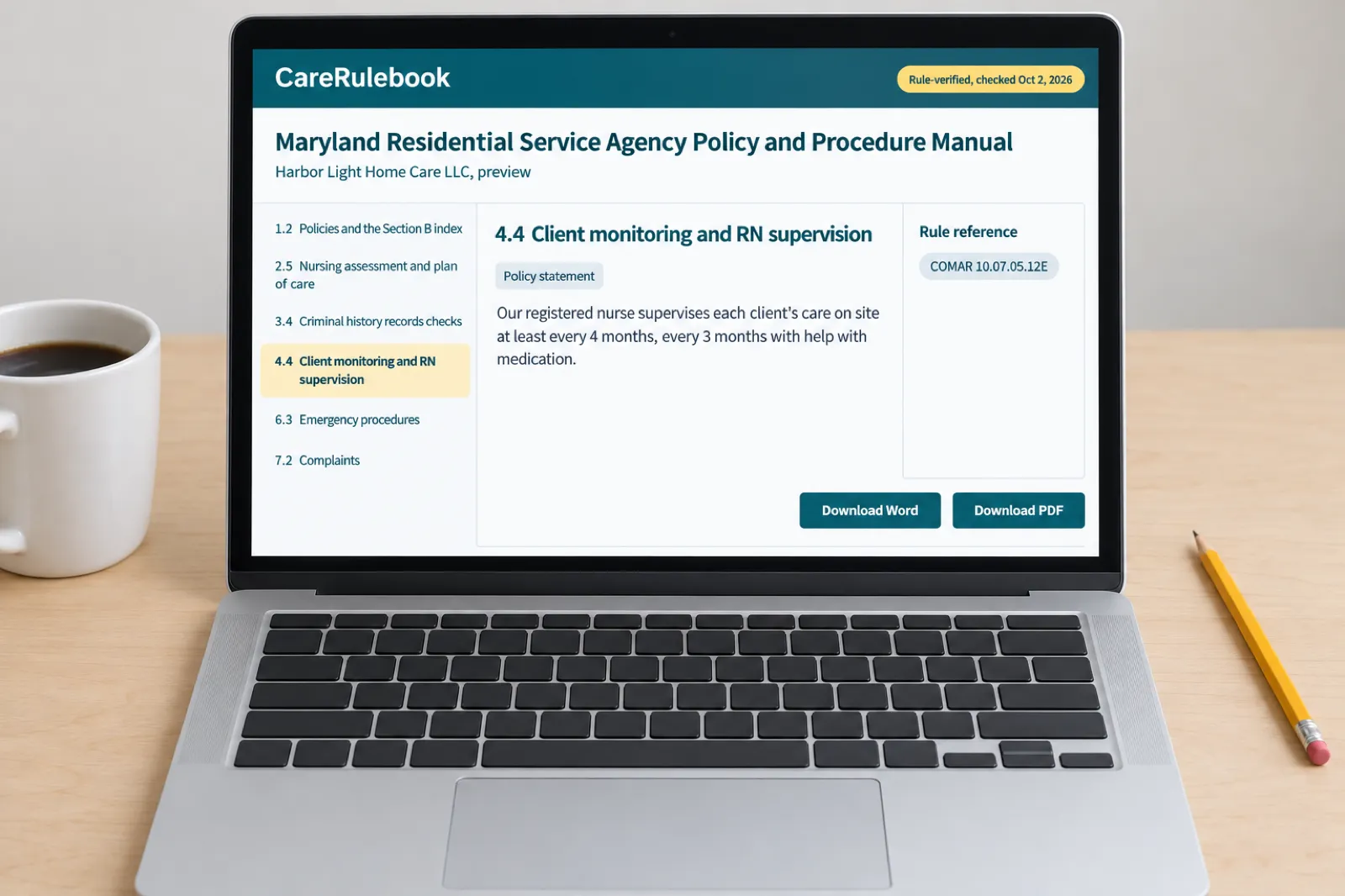
CareRulebook’s Maryland manual includes Policy 4.2 on medication, written for the level of help you choose, with Policy 4.4 on RN supervision and Policy 3.6 on certified and uncertified caregivers. Your registered nurse reads and adopts each clinical policy.
$199CareRulebook founding price for the first 50 Maryland agencies, then $249. Not an OHCQ fee.
No. Medication administration is a nursing function: licensed staff give medications, and a nurse may delegate some of it to certified medication technicians and medicine aides only within the Board of Nursing’s limits. OHCQ’s trainer checklist says CMTs may not calculate doses or fill pill boxes, and aides without RN-supervised medication management must never administer medications, though they may remind clients who take their own. By our reading, no aide should fill pill organizers. An uncertified aide may help a client with self-administration only after the client signs an informed consent form.
"Administration of medication is a nursing function. As such, the nurse retains full responsibility for medication administration."
No. Not on a nursing assistant certificate alone. Medication administration is a nursing function, and a nurse may delegate it only to certified medication technicians and certified medicine aides (a CNA who has also completed a Board-approved medication course), within the Board’s limits on medications, routes and settings. OHCQ’s 2020 slides also said waivers never permit administration by CNAs or unlicensed aides.
"may be delegated to certified medicine aides and medication technicians only"
No. Only a cognitively capable adult client, not a client representative, may waive the agency’s recommendation of certified care for help with the self-administration of medication, and the informed consent form for help from a nonlicensed person is signed by the client. By our reading, if the client cannot make that decision, the agency provides or refers certified or licensed help instead.
"A cognitively capable adult client, but not a client representative with legal authority to make health care decisions, may waive the licensee’s recommendation of certified care services"
Not on an aide or nursing assistant certificate alone. Medication administration is a nursing function. In a residential service agency it is done by licensed nurses or by staff the Board of Nursing has certified as medication technicians or medicine aides, working under a registered nurse’s delegation, only as the physician orders. An aide may help a client who takes their own medication once the client has signed an informed consent form, and OHCQ says nursing assistants without RN-supervised medication management may remind clients who self-administer.
Not certified medication technicians: the Board’s rules say a medication technician may not fill medication assistive devices such as mediplanners or time-dose containers, and OHCQ’s trainer checklist says the same. Aides have less authority than technicians, so by our reading no aide should fill one either. A client, a family member, the pharmacy or a nurse can.
The rules do not say whether a reminder counts as assistance with the self-administration of medications. If it does, the client signs an informed consent form first and the RN supervises on site every 3 months instead of every 4. By our reading, treat reminders as that assistance until OHCQ says otherwise; the question is on our list for OHCQ.
The consent for help from a nonlicensed person is signed by the client, and only a cognitively capable adult client, not a client representative, may waive the agency’s recommendation of certified care for help with self-administration. If the client cannot make that decision, by our reading the agency provides or refers certified or licensed help instead.
By completing a 20-hour Board-approved course, taught by registered nurses, with 4 of the hours on common disease processes and high-risk medications for the setting where they will work, and being certified by the Board of Nursing. Applicants are 18 or older and, under the Board’s emergency amendments in effect since August 25, 2026, submit to a criminal history records check. The certificate is renewed every 2 years with a clinical refresher course and 100 hours of practice.
The Board’s rules let a nurse delegate medication by subcutaneous injection to a medication technician if the nurse has calculated the dose, and OHCQ’s trainer checklist lists subcutaneous and finger sticks among technician routes. The same rules limit where a nurse may delegate medication administration, and a client’s own home is not named. Ask OHCQ and the Board before you offer it.
The RSA rule says drugs and treatments are administered only as ordered by the physician, and orders may be accepted with an electronic signature. Whether an order from a nurse practitioner or physician assistant meets that wording is not answered in the sources we checked; it is on our list of questions for OHCQ. A medication technician may not transcribe verbal orders.
The Board of Nursing’s criminal history checks for all its certificate holders, including medication technicians, are in force as emergency rules while the permanent rules (26-127-P) are proposed, and OHCQ has signalled a 2026 update to the RSA training rules. Leave your email and we will tell you when a Maryland change affects your medication policy.
No spam. Only emails about Maryland home care rule changes. How we use your email.
Maryland
How to start a home care agency in Maryland
The RSA license, the 23 policy items, background checks and the fee question.
Maryland
The registered nurse in a Maryland RSA
Assessment, the plan of care, delegation and the RN’s on-site visits every 4 months, 3 months or 45 days.
Manual
Build your Maryland policy manual
Including Policy 4.2 on medication and Policy 5.1 on informed consent and waivers.
Maryland
Maryland RSA policies and procedures
The 23 items OHCQ indexes in Section B, including administration of drugs and the consent items.
Maryland
Maryland caregiver training
The seven COMAR topics, OHCQ’s medication training limits, certified and uncertified caregivers and CNA-I and CNA-II.
Maryland
Maryland home health vs home care
The RSA, the nursing referral service agency and the home health agency, side by side.
Tennessee
Medication in a Tennessee PSSA
Medication assistance, and administration by staff certified through DDA’s 20-hour class.
Virginia
Virginia home care administrator and RN requirements
The registered nurse who supervises personal care at least every 90 days.